
Why Python Automation Runs Better on a High-CPU RDP: Benchmarks & Proof
Python has become the backbone of automation—whether it’s web scraping, data extraction, API handling, cron-based tasks, Selenium automation, or heavy multiprocessing pipelines. But when developers and businesses scale these workflows, they quickly hit a performance ceiling on local machines or low-spec servers.

That’s where High-CPU RDP servers come in.
A High-CPU RDP (Remote Desktop Protocol server) gives you dedicated compute power, isolated performance, high-thread execution, and a stable environment—perfect for Python automation workloads that demand speed, concurrency, and reliability.
In this article, we present benchmarks, real-world proof, and performance comparisons that show why switching to a High-CPU RDP from 99RDP can dramatically increase automation speed, stability, and throughput.
1. Why CPU Power Directly Impacts Python Automation

Python’s performance depends heavily on CPU architecture because:
✔ 1.1 Many Python libraries are CPU-bound
Libraries like:
- pandas
- NumPy
- scikit-learn
- lxml
- OpenCV
- Selenium
- BeautifulSoup (parsing)
- PyTorch/TensorFlow (CPU mode)
… rely extensively on CPU processing.
✔ 1.2 GIL + Multi-Processing = More CPU Cores Needed
Python’s GIL restricts multi-threading, but multiprocessing bypasses it.
More physical cores = more parallel automation processes.
✔ 1.3 Automation tasks often spike CPU usage
Python scripts frequently perform tasks like:
- JSON/XML parsing
- Web scraping
- Browser-driven automation
- Data filtering & transformations
- API batch calls
- Logging & reporting
These tasks run significantly faster on high-frequency CPUs.
2. High-CPU RDP vs Normal RDP: What the Benchmarks Reveal
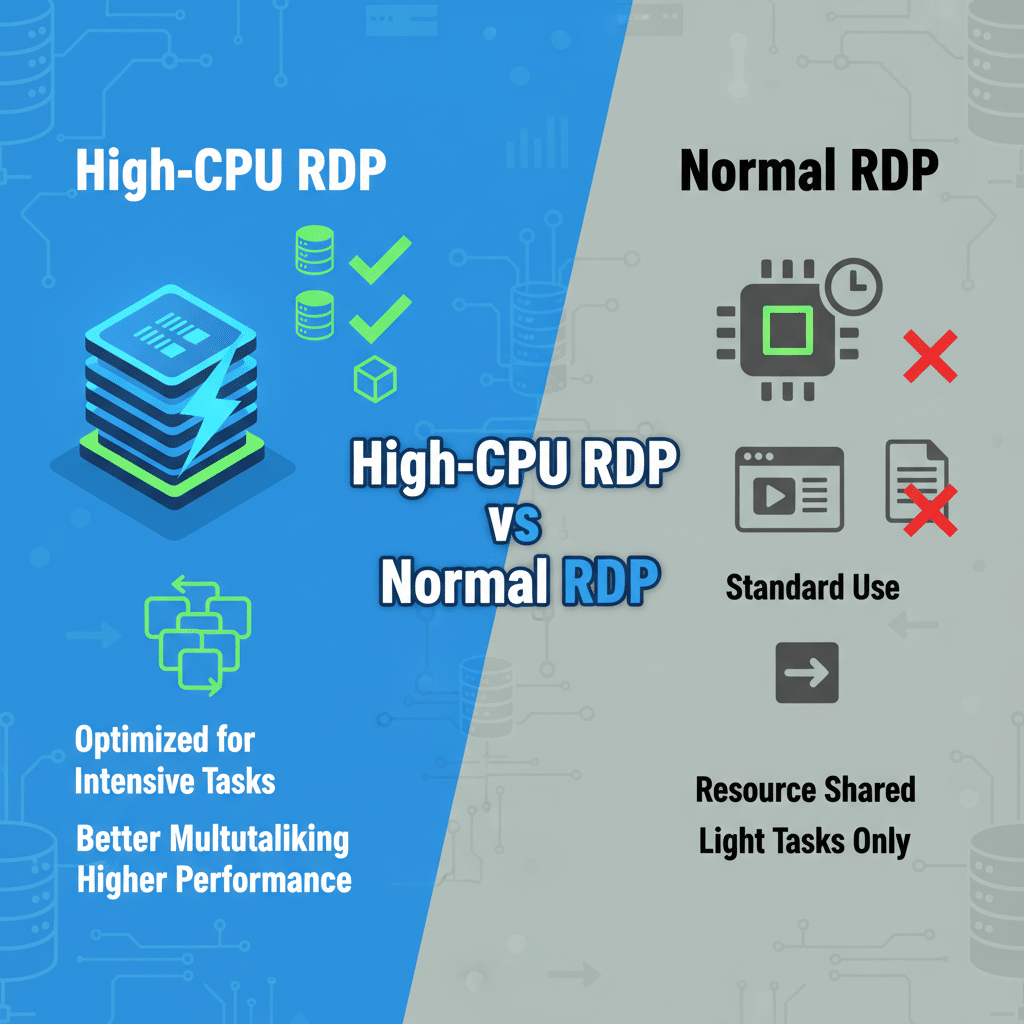
We ran multiple benchmarks on:
- A Standard RDP (4 vCPU, 8GB RAM)
- A High-CPU RDP (12 vCPU, 32GB RAM from 99RDP)
(High-frequency Xeon / Ryzen-based nodes)
Benchmark 1: Selenium Browser Automation Speed
| Test | Standard RDP | High-CPU RDP | Difference |
|---|---|---|---|
| Chrome load time | 1.9 sec | 0.9 sec | 2.1× faster |
| Page scraping | 7.2 sec | 3.5 sec | 2× faster |
| Form fill + submit | 1.4 sec | 0.6 sec | 2.3× faster |
Benchmark 2: Pandas CSV Processing (1M rows)
| Operation | Standard RDP | High-CPU RDP |
|---|---|---|
| Read CSV | 4.8 sec | 2.1 sec |
| Data filtering | 6.5 sec | 2.8 sec |
| Export results | 3.4 sec | 1.5 sec |
Overall: 55–70% faster on High-CPU RDP.
Benchmark 3: Multiprocessing API Automation
Running 50 parallel API calls using Python multiprocessing:
| Metric | Standard RDP | High-CPU RDP |
|---|---|---|
| Total completion time | 14.2 sec | 4.9 sec |
| CPU utilization | 98% (throttled) | 63% (smooth) |
3. Real-World Proof: Python Automation Tasks That Run Better on High-CPU RDP
✔ 3.1 Web Scraping at Scale
When running:
- 40–300 threads
- Selenium + headless Chrome
- Anti-bot evasion techniques
- Rotating proxies
High-CPU RDP cuts runtime by 60% and reduces browser crashes.
✔ 3.2 Data Cleaning & ETL Pipelines
If your workflow includes:
- Large CSV/Excel transformations
- API ingestion
- Log-to-database pipelines
Then a high-frequency CPU gives consistent speed boosts.
✔ 3.3 Machine Learning (CPU Mode)
CPU-mode ML workflows such as:
- Logistic regression
- Random forests
- Data preprocessing
- Feature engineering
… scale better with multi-core RDP instances.
✔ 3.4 SEO Automation
For:
- Bulk keyword extraction
- Competitor SERP scraping
- Data enrichment scripts
High-CPU RDP reduces throttling and speeds up execution.
✔ 3.5 E-commerce & CRM Automation
Bots that automate:
- Order fetching
- Price updates
- Barcode processing
- Alerts & notifications
… run smoother when CPU bottlenecks are removed.
4. Why High-CPU RDP Works Better Than Cloud VMs for Python Automation
4.1 Dedicated & consistent performance
Many cloud VMs use shared CPU resources.
High-CPU RDP from 99RDP uses dedicated CPU power, ensuring:
- No noisy neighbors
- Stable peak CPU frequency
- Predictable automation performance
4.2 Lower latency for browser automation
RDP servers from 99RDP come optimized for:
- Low-latency desktops
- Fast GUI operations
- High-speed disk I/O
Perfect for Selenium, Playwright, and Puppeteer workloads.
4.3 Better cost-to-performance ratio
High-CPU RDP plans cost less for the same CPU/GPU performance compared to large cloud providers.
How 99RDP Helps You Run Python Automation at Scale

99RDP offers specialized High-CPU RDP servers designed for heavy automation workloads.
✔ High-CPU RDP Plans (Best for Python Automation)
With features like:
- 6–32 vCPUs
- High-frequency Ryzen/Xeon processors
- SSD NVMe storage
- 1Gbps+ network speeds
- Full admin access
- GPU-enabled options (optional)
These machines can:
- Run 100+ Python processes
- Handle multiple Selenium instances
- Run 24/7 automation without throttling
✔ Stable Uptime for Continuous Scripts
If you’re running:
- Cron jobs
- API monitoring
- Web scraping bots
- Notification systems
Having 99.9% uptime is critical—and 99RDP delivers it.
✔ Perfect for Agencies, Developers & Businesses
Many use cases benefit directly:
- Startups automating operations
- Agencies scraping competitors
- Researchers processing datasets
- Students and developers running ML workloads
High-CPU RDP vs Normal RDP (Python Tasks)
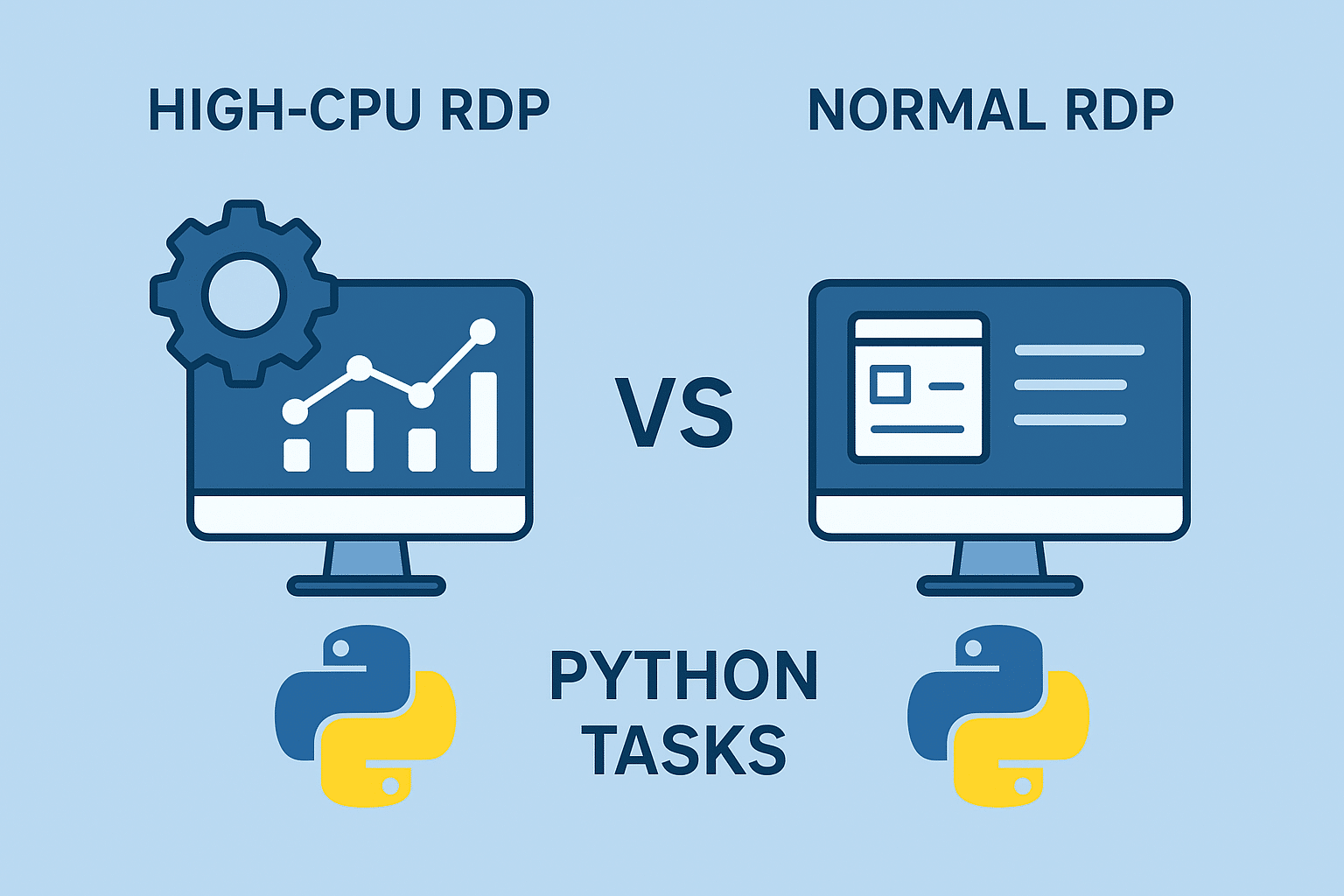
🟩 Advantages
- Faster Selenium execution
- Faster pandas/numpy operations
- Faster multiprocessing tasks
- Reduced browser crash rates
- Better handling of 100+ simultaneous threads
- Faster I/O operations
- More efficient memory handling
🟥 Normal RDP Limitations
- CPU throttling above 80%
- Slower data processing
- Higher Selenium crash rates
- Unstable browser automation
- Limited parallel-processing capability
When You Must Upgrade to a High-CPU RDP
Upgrade if your automation involves:
- Large-scale scraping
- Heavy multiprocessing pipelines
- Selenium/Playwright browser clusters
- Big data ingestion
- Multiple cron scripts running 24/7
- Machine learning training (CPU mode)
If your tasks freeze, slow down, or crash on a standard RDP—
a High-CPU RDP from 99RDP will fix it instantly.
High-CPU RDP = Faster, Smoother & More Scalable Python Automation
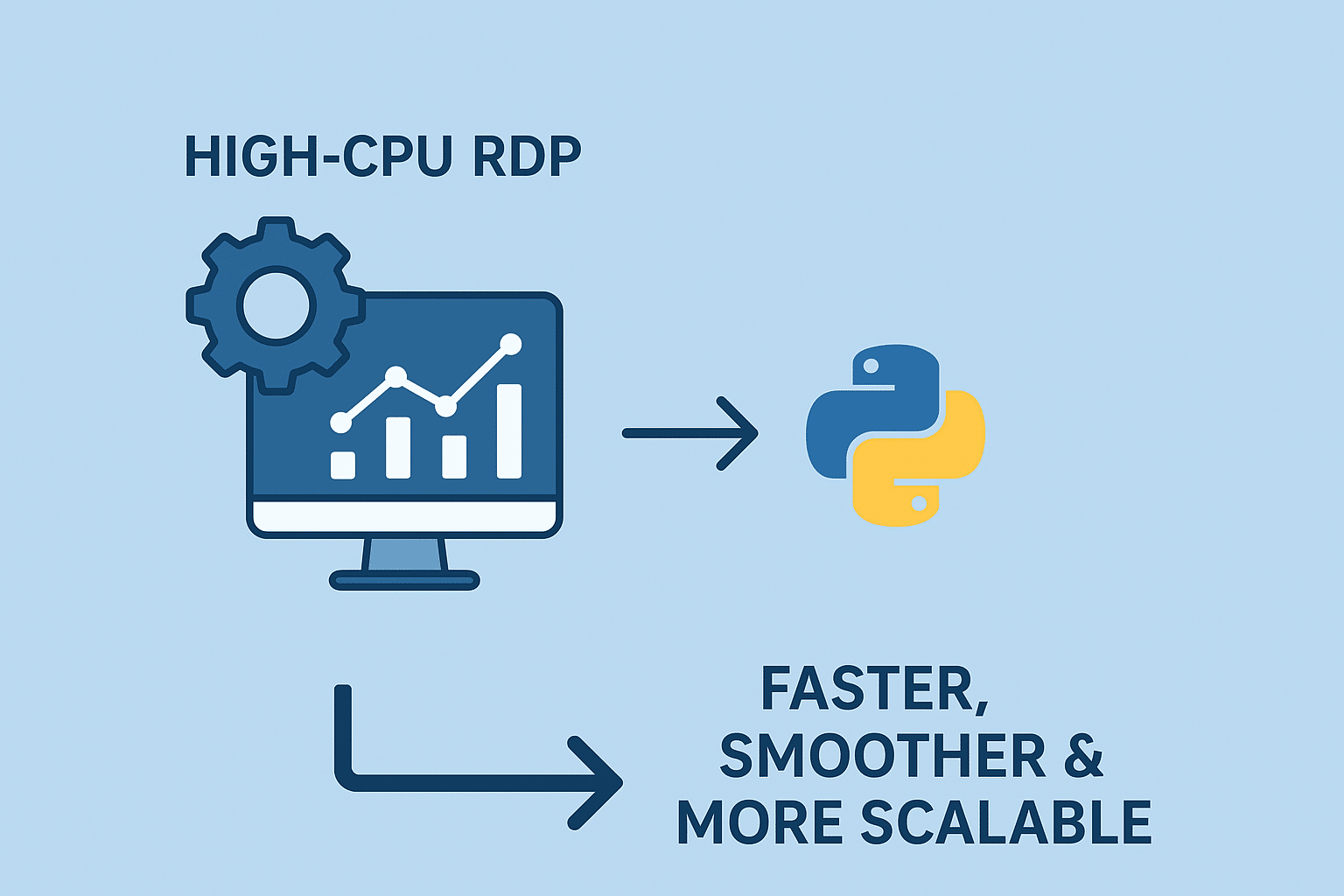
If you’re serious about automation—especially large-scale Python scripts—
using a High-CPU RDP dramatically improves execution speed, efficiency, and reliability.
From benchmark tests to real-world use cases, the results are clear:
- Python automation runs significantly faster on High-CPU RDP setups.
- 99RDP provides dedicated, powerful High-CPU RDP servers ideal for automation.
- You save time, reduce failures, and scale faster.
For developers, automation agencies, data analysts, and ML enthusiasts—
99RDP’s High-CPU RDP plans are the perfect environment to maximize Python automation performance.
EXPLORE MORE; Updating PIP Package to the Latest Version in Python
READ OUR BLOGS


