
Colocation vs VPS in Forex Trading
A Deep Technical Breakdown of Latency, Infrastructure, and Execution Efficiency

Trading Performance is an Infrastructure Problem
Modern Forex trading is no longer just about indicators, price action, or macroeconomic analysis. In today’s algorithm-driven environment, infrastructure plays a decisive role in profitability. Execution speed, network latency, uptime guarantees, and system reliability directly influence how accurately your trades reflect your strategy.
Even a delay of 5–50 milliseconds can result in:
- Slippage during volatile market conditions
- Missed arbitrage opportunities
- Execution at suboptimal price levels
This is why traders—especially those running automated systems—must choose between two primary infrastructure models:
- Virtual Private Servers (VPS)
- Colocation environments
Both aim to reduce latency and improve execution, but they differ significantly in architecture, cost, and real-world impact.
What is a Forex VPS?

A Forex VPS (Virtual Private Server) is a virtualized computing environment hosted in a data center, allowing traders to run trading platforms like MetaTrader 4 and MetaTrader 5 continuously without relying on a local machine.
Technical Characteristics:
- Hosted on hypervisor-based virtualization (e.g., KVM, Hyper-V)
- Shared physical hardware with isolated virtual instances
- Remote desktop access via RDP
- Configurable CPU, RAM, and storage
Operational Advantages:
- 24/7 uptime independent of local power/internet
- Reduced latency via proximity to broker servers
- Support for automated trading bots (Expert Advisors)
- Rapid deployment and scalability
Typical Performance Metrics:
- Latency: 1 ms – 10 ms (depending on server location)
- Uptime: 99.9%+ SLA
- Cost: $15–$80/month
What is Colocation in Forex Trading?
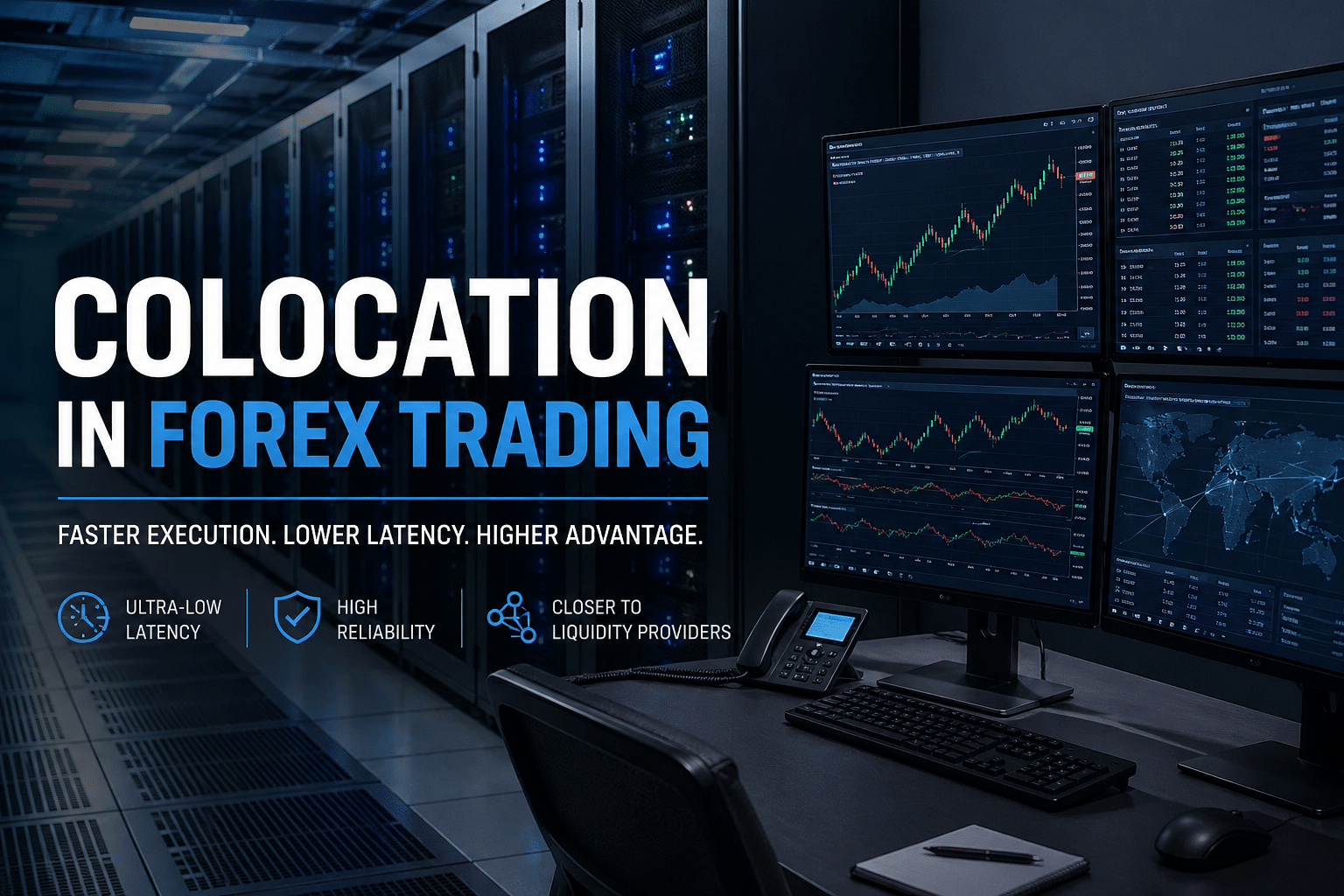
Colocation involves placing your physical trading server inside the same data center as your broker’s matching engine.
Technical Characteristics:
- Bare-metal server (no virtualization overhead)
- Direct fiber cross-connect to broker infrastructure
- Ultra-low latency networking
- Dedicated hardware resources
Operational Advantages:
- Minimal network hops
- Deterministic latency
- Maximum execution precision
Typical Performance Metrics:
- Latency: 0.1 ms – 3 ms
- Uptime: 99.99%+ (enterprise-grade)
- Cost: $200–$1000+/month
Latency Engineering: The Real Battleground
Latency is the time it takes for your trading order to travel from your system to the broker’s server and back.
Components of Latency:
- Network latency – physical distance + routing efficiency
- Processing latency – system and OS overhead
- Broker execution latency – internal matching engine delay
Why It Matters:
- A 10 ms delay can shift price execution during high volatility
- Arbitrage strategies rely on sub-5 ms execution windows
- Scalping performance degrades exponentially with latency increase
Latency Benchmarks in Real Trading
| Latency Range | Impact on Trading |
|---|---|
| <1 ms | Institutional-grade (HFT, arbitrage) |
| 1–5 ms | Ideal for scalping & high-frequency bots |
| 5–20 ms | Acceptable for most retail strategies |
| 20–100 ms | Moderate performance degradation |
| >100 ms | High slippage risk |
Colocation dominates the sub-5 ms category, while a well-optimized VPS comfortably operates in the 1–10 ms range.
VPS vs Colocation: A Systems-Level Comparison
1. Architecture
VPS:
- Runs on virtualized infrastructure
- Shares physical hardware resources
- Slight overhead due to hypervisor
Colocation:
- Direct hardware access
- No virtualization layer
- Maximum performance efficiency
Insight: Virtualization overhead typically adds 1–2 ms latency, which is negligible for most traders.
2. Network Topology
VPS:
- Routed through optimized data center networks
- May involve multiple hops
Colocation:
- Direct cross-connect to broker servers
- Near-zero routing complexity
Insight: Network topology is the primary reason colocation achieves ultra-low latency.
3. Cost Efficiency
VPS:
- Low entry cost
- Pay-as-you-scale model
Colocation:
- High upfront hardware investment
- Recurring rack space + bandwidth costs
Insight: VPS delivers ~85% performance at ~10–20% cost.
4. Deployment & Maintenance
VPS:
- Instant provisioning
- Managed infrastructure
- No hardware maintenance
Colocation:
- Requires server procurement
- Manual setup and maintenance
- Requires networking expertise
Insight: VPS removes DevOps complexity, making it accessible to retail traders.
5. Scalability
VPS:
- Upgrade CPU/RAM instantly
- Spin up multiple instances
Colocation:
- Scaling requires physical hardware upgrades
Insight: VPS is significantly more flexible for multi-account trading environments.
Strategy-Driven Infrastructure Selection
VPS is Optimal For:
1. Algorithmic Trading (EAs)
- Continuous execution required
- Moderate latency tolerance
2. Scalping Strategies
- Requires low latency (<10 ms)
- VPS near broker achieves sufficient performance
3. Swing & Position Trading
- Latency has minimal impact
- Stability and uptime matter more
Colocation is Essential For:
1. Latency Arbitrage
- Requires sub-3 ms latency
- Exploits price discrepancies across brokers
2. High-Frequency Trading (HFT)
- Microsecond-level decision-making
- Requires deterministic execution
3. Institutional Trading Systems
- Multi-server architectures
- Advanced networking setups
The Hidden Truth: Diminishing Returns of Ultra-Low Latency
While colocation offers the lowest latency, the performance gains are not linear.
Example:
- Reducing latency from 100 ms → 10 ms = massive improvement
- Reducing latency from 10 ms → 1 ms = marginal gain for most strategies
Conclusion: For 90% of retail traders, the difference between 2 ms and 8 ms is negligible compared to:
- Strategy quality
- Risk management
- Market conditions
Practical Optimization: Getting the Most Out of VPS
To maximize VPS performance:
1. Choose the Right Server Location
- Select a VPS near your broker’s data center
- Common hubs: London, New York, Tokyo
2. Optimize Trading Platform
- Minimize indicators
- Use lightweight Expert Advisors
- Reduce chart load
3. Monitor Resource Usage
- Avoid CPU/RAM bottlenecks
- Upgrade plan when needed
Strategic Advantage: Using 99RDP Forex VPS
For traders seeking a balance between performance, reliability, and cost, solutions like:
99RDP Forex VPS
https://99rdp.com/forex-vps/
offer a production-ready environment optimized for trading workloads.
Why It Fits Technically:
✔ Low-Latency Infrastructure
Servers are positioned to minimize network distance between trader and broker, improving execution speed.
✔ High Uptime Reliability
Ensures uninterrupted operation of MetaTrader 4 and MetaTrader 5 platforms.
✔ Resource Optimization
Balanced CPU and RAM configurations support:
- Multiple trading accounts
- Simultaneous Expert Advisors
✔ Simplified Deployment
No need for:
- Hardware setup
- Network configuration
- System maintenance
Real-World Impact:
Using a Forex VPS like 99RDP enables:
- Continuous trading (24/7 execution)
- Reduced slippage during volatility
- Improved trade consistency
Case Study Scenario
Trader A: Local Machine Setup
- Latency: 120 ms
- Frequent disconnections
- Missed trades during power outages
Trader B: VPS (e.g., 99RDP)
- Latency: 5 ms
- Stable uptime
- Consistent execution
Result: Trader B experiences better fill rates, fewer missed trades, and improved profitability consistency.
VPS vs Colocation
Choose VPS if:
- You are a retail trader
- You use EAs or semi-automated strategies
- You want reliable, cost-effective infrastructure
- Your latency requirement is >3 ms
Choose Colocation if:
- You run arbitrage or HFT strategies
- Your edge depends on microseconds
- You can justify high infrastructure costs
Key Takeaways:
- VPS solves 90% of real-world trading problems
- Colocation is niche but powerful
- Infrastructure should match strategy—not the other way around
For most traders, starting with a high-performance Forex VPS like 99RDP is the smartest move. It delivers:
- Low latency
- High uptime
- Operational simplicity
Only upgrade to colocation when your strategy demands ultra-low latency at scale.
Conclusion
Forex trading success is increasingly tied to technical infrastructure optimization. While colocation represents the pinnacle of low-latency engineering, VPS solutions provide a practical, scalable, and cost-efficient alternative.
In a market where milliseconds matter—but strategy matters more—choosing the right infrastructure is about balancing performance with practicality.
Build your trading stack intelligently. Start lean. Scale when necessary.
EXPLORE MORE ; VPS Server Germany | Affordable VPS Germany | Germany VPS Hosting

READ OUR BLOGS


