
How Atomic Distros Transform DevOps & CI/CD

Modern DevOps teams move at high velocity. Code ships multiple times per day. Containers are rebuilt constantly. Infrastructure is treated as code. Yet one fragile layer often remains overlooked: the operating system itself.
Traditional Linux distributions update package-by-package. A kernel upgrade succeeds, but a library fails. A dependency conflict breaks CI agents. A security patch leaves inconsistent states across nodes. These “small” OS inconsistencies cause pipeline failures, rollback chaos, and wasted engineering hours.
Atomic (immutable) Linux distributions solve this structural problem at its core.
In this deep technical guide, we’ll explore how atomic distros — such as Fedora Silverblue, Fedora Kinoite, and container-focused systems powered by OSTree — are fundamentally transforming DevOps and CI/CD architectures. We’ll also show how deploying them on high-performance remote infrastructure like 99RDP unlocks their full production potential.
1. The Core Problem: Mutable Systems Break Predictability
Traditional Linux systems rely on package managers (APT, DNF, YUM, etc.) that modify the live filesystem directly.
The DevOps Pain Points
- Partial updates leave systems in inconsistent states
- CI agents behave differently across nodes
- Rolling back OS updates is complex and risky
- Drift occurs between staging and production
- Security patching introduces regressions
In high-scale DevOps environments, even a 1% failure rate in OS upgrades can cascade into deployment failures and lost developer productivity.
Atomic distros eliminate this by changing the OS update model entirely.
2. What Makes an Atomic Distro “Atomic”?
Atomic Linux distributions use a transactional, image-based update system.
Instead of modifying the running OS:
- The entire system image is updated as a single unit
- Changes are staged in a separate deployment
- A reboot activates the new image
- Rollback is immediate if something fails
Most atomic systems leverage OSTree, which works like Git for operating systems. The root filesystem is versioned, immutable, and reproducible.
Key Architectural Features
- Read-only base OS
- Transactional updates
- Rollback support
- Separation of system and applications
- Container-first design
This architecture aligns perfectly with DevOps philosophies.
3. Immutable Infrastructure Meets Immutable OS
DevOps promotes immutable infrastructure — rebuild, don’t mutate.
Atomic Linux extends this concept to the operating system layer.
Traditional Model
- Configure server
- Patch over time
- Install packages manually
- Drift accumulates
Atomic Model
- Deploy known image
- Rebuild instead of modify
- Updates are version-controlled
- Environments remain identical
This dramatically improves:
- Reproducibility
- Auditability
- Reliability
- Deployment confidence
For CI/CD pipelines, consistency is everything.
4. How Atomic Distros Improve CI/CD Pipelines

4.1 Deterministic Build Agents
CI agents running on atomic distros:
- Always boot into a known-good OS state
- Cannot accidentally mutate system libraries
- Maintain identical behavior across environments
This prevents “pipeline works on one runner but not another” scenarios.
4.2 Safe OS Updates During Sprint Cycles
Traditional OS updates during active development are risky.
Atomic distros allow:
- Staged updates
- Test before activation
- Instant rollback
DevOps teams can update build nodes without fearing pipeline collapse.
4.3 Zero-Downtime Update Strategy
Because updates are transactional:
- Systems download updates in the background
- Activation occurs on reboot
- Previous deployment remains available
In production clusters, this enables rolling reboots with minimal disruption.
4.4 Faster Incident Recovery
If a new OS image introduces regression:
rollback
reboot
resolved
No complex package downgrades. No broken dependencies. No manual repair.
For DevOps incident response, this is transformative.
5. Container Synergy: Atomic + Kubernetes
Atomic distros are optimized for containerized environments.
Why?
Because:
- Applications live in containers
- OS remains stable and minimal
- System surface area is reduced
In Kubernetes clusters:
- Node consistency increases
- Attack surface shrinks
- Drift between worker nodes disappears
Atomic systems align naturally with cloud-native architecture.
Security Advantages in DevSecOps
Security is integral to modern CI/CD.
Atomic distros enhance security through:
✔ Reduced Attack Surface
Minimal base systems reduce exposed services.
✔ Integrity Protection
Read-only root prevents unauthorized modifications.
✔ Verifiable Updates
OSTree-based systems allow cryptographic verification of system images.
✔ Simplified Compliance
Versioned deployments provide clear audit trails.
For organizations implementing DevSecOps, immutable OS design strengthens defense-in-depth strategies.
Performance Considerations in DevOps Environments
Atomic distros benefit from:
- Faster boot times
- Lower configuration overhead
- Streamlined update logic
However, CI/CD environments demand more than architectural elegance.
They require:
- High IOPS storage
- Multi-core CPUs
- Stable networking
- Dedicated resources
This is where infrastructure becomes critical.
Deploying Atomic Distros on 99RDP
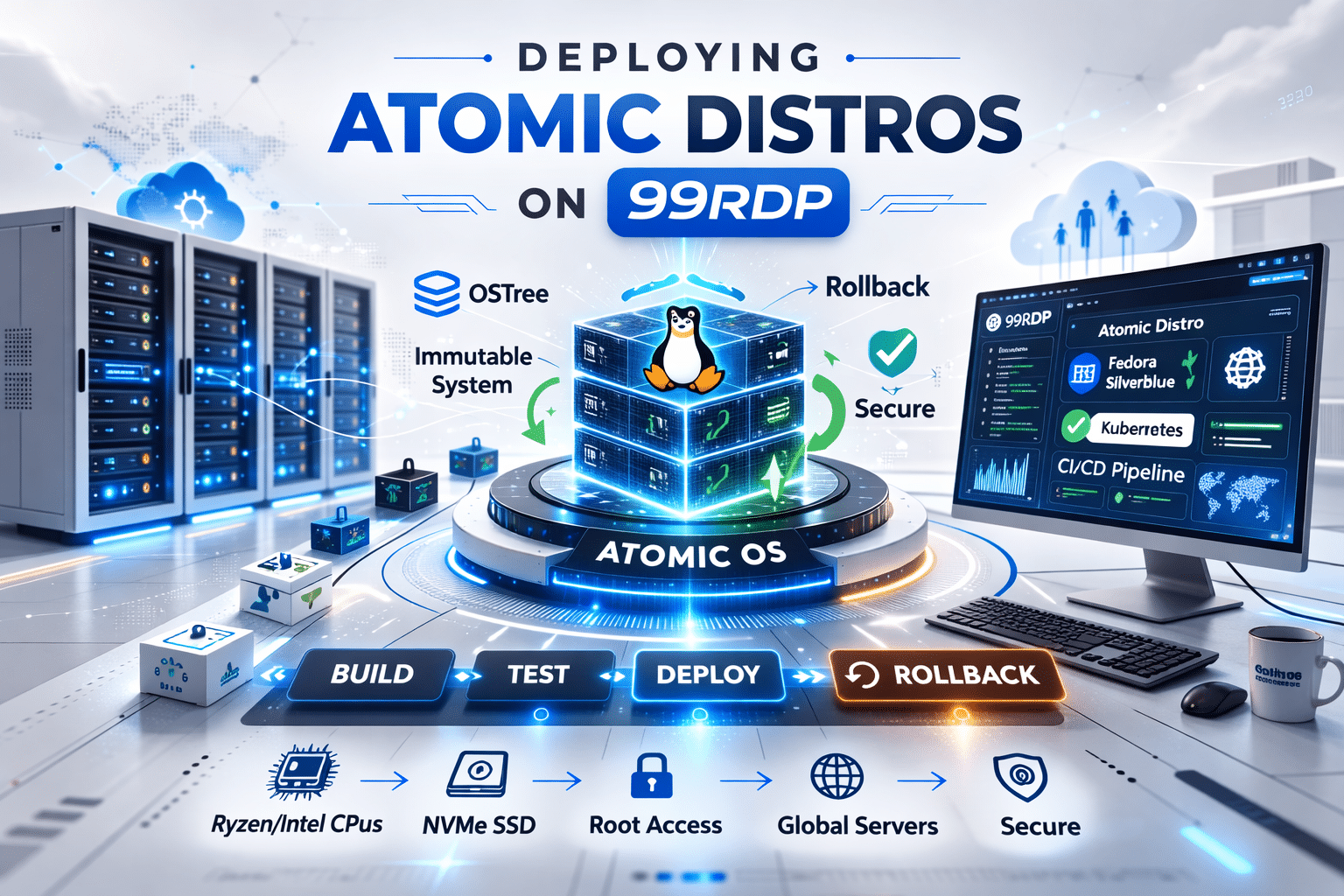
Atomic distros are powerful — but they must run on reliable hardware.
99RDP’s Linux VPS and RDP environments provide:
High-Performance CPUs
Multi-core processors ideal for:
- Parallel builds
- Docker image creation
- Kubernetes testing
- CI runner workloads
NVMe SSD Storage
Atomic updates and container builds benefit from:
- High-speed disk writes
- Fast image downloads
- Snapshot efficiency
Full Root Access
DevOps teams need control.
On 99RDP, you can:
- Install atomic distributions
- Configure OSTree-based workflows
- Deploy custom CI runners
- Integrate container engines
Global Low-Latency Access
Distributed teams require remote access.
99RDP’s remote desktop and VPS solutions allow:
- Developers to manage CI nodes globally
- DevOps engineers to monitor builds remotely
- Secure SSH and RDP access
Ideal for CI/CD Labs & Testing
Atomic distros thrive in:
- Dev environments
- Staging clusters
- Automated testing servers
- Sandbox infrastructure
Using 99RDP, teams can spin up isolated atomic environments for:
- Kernel testing
- Build agent validation
- OS upgrade simulations
Without affecting production.

Real-World DevOps Scenarios Transformed
Scenario 1: Enterprise CI Pipeline Stability
Before atomic adoption:
- 3% of builds fail due to environment inconsistencies
- OS updates require maintenance windows
After atomic deployment:
- Identical runners across regions
- Rollback capability reduces incident recovery time
Scenario 2: SaaS Deployment Infrastructure
Atomic OS ensures:
- Application containers remain isolated
- OS layer never drifts
- Security patches apply consistently
Deployed on 99RDP high-performance VPS nodes, this creates predictable production environments.
Scenario 3: Developer Workstations for Cloud Teams
Using Fedora Silverblue:
- Developers test container builds locally
- System corruption risk drops
- Rollback prevents downtime
Hosted on 99RDP Linux RDP servers, teams access powerful remote dev environments from anywhere.
10. Atomic Distros vs Traditional Linux in DevOps
| Feature | Traditional Linux | Atomic Linux |
|---|---|---|
| Update Model | Package-based | Image-based |
| Rollback | Manual & complex | Instant |
| Drift Risk | High | Minimal |
| CI Consistency | Variable | Deterministic |
| Security | Depends on config | Built-in immutability |
For DevOps teams optimizing reliability and velocity, atomic architecture wins.
Strategic Advantages for Growing Teams
As organizations scale:
- More CI agents
- More deployments
- More environments
- More complexity
Atomic distros reduce operational overhead by:
- Standardizing system states
- Automating update safety
- Eliminating configuration drift
- Simplifying maintenance
Combined with scalable infrastructure from 99RDP, this becomes a powerful DevOps backbone.
The Future: GitOps + Atomic OS
The DevOps future is converging toward:
- GitOps workflows
- Declarative infrastructure
- Container-native architecture
- Immutable systems
Atomic Linux integrates seamlessly with this direction.
Imagine:
- OS versions managed like Git commits
- Infrastructure declared as code
- CI/CD pipelines running on immutable nodes
- Production clusters that self-heal
This is not theoretical — it is already happening.
Final Thoughts
Atomic Linux distributions represent a structural evolution in operating system design. They replace fragile, mutable update models with transactional, rollback-ready systems that align perfectly with DevOps principles.
For CI/CD pipelines, this means:
- Deterministic environments
- Reduced failure rates
- Faster recovery
- Improved security
- Lower operational stress
When deployed on high-performance, globally accessible infrastructure like 99RDP’s Linux VPS and RDP solutions, atomic distros become not just stable — but production-grade powerhouses for modern DevOps teams.
The future of DevOps is immutable.
The future of CI/CD is atomic.
EXPLORE MORE ; Shadowsocks for Students, Gamers & Developers: Supercharge it with 99RDP

READ OUR BLOGS


