
GNOME 51 Alpha for Developers: Exploring the Future of the Linux Desktop Experience

The Linux desktop landscape never stands still. Every release cycle brings refinements that shape how developers, system administrators, and enterprises interact with open-source computing environments. The arrival of GNOME 51 Alpha marks the beginning of another important development cycle, offering an early look at what could become one of the most polished and developer-friendly Linux desktop experiences yet.
Although this is an alpha release intended primarily for testing and feedback, GNOME 51 already provides valuable insights into where the Linux desktop ecosystem is heading. From improved hardware state management to continued performance optimization and smarter system monitoring capabilities, the release reflects GNOME’s ongoing commitment to creating a modern, efficient, and scalable desktop environment.
For developers, early testing is more than curiosity. It is an opportunity to prepare applications, workflows, and infrastructure for upcoming changes while contributing to one of the world’s most influential open-source projects.
Understanding GNOME’s Role in the Linux Ecosystem
GNOME is one of the most widely adopted desktop environments in the Linux world. It powers major Linux distributions, including Ubuntu, Fedora, Debian, Red Hat Enterprise Linux, and countless derivative distributions used by developers and enterprises worldwide.
Its popularity stems from several principles:
- Clean and minimal user interface
- Strong accessibility support
- Consistent design language
- Modern application framework
- Deep Wayland integration
- Robust open-source community support
Unlike desktop environments that prioritize extensive customization, GNOME focuses on creating a streamlined and distraction-free experience that allows users to remain productive.
For developers, this philosophy often translates into:
- Reduced interface complexity
- Better workflow consistency
- Fewer maintenance overheads
- Improved system stability
- Enhanced focus during development tasks
Over the years, GNOME has evolved from a traditional desktop environment into a sophisticated platform capable of supporting modern software engineering workflows, containerized applications, cloud administration, and remote development environments.
Why GNOME 51 Alpha Matters
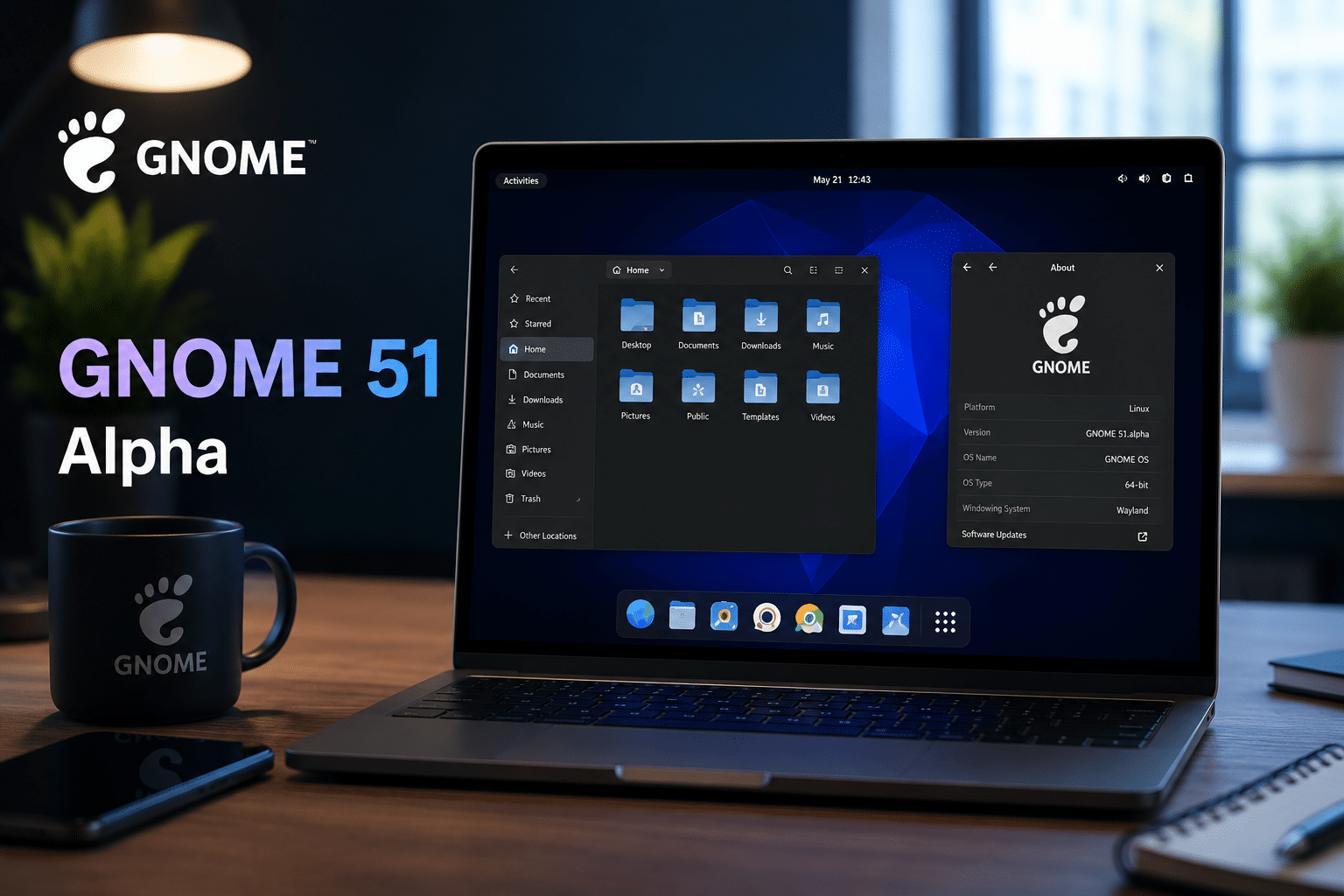
Alpha releases are often misunderstood. They are not intended to replace stable production systems. Instead, they represent an early milestone that allows developers and testers to evaluate new capabilities, identify issues, and influence the direction of the final release.
The GNOME development cycle follows a structured approach:
- Alpha Release
- Beta Release
- Release Candidate
- Stable Public Release
This process offers several advantages:
Early Compatibility Testing
Developers can determine whether their applications continue to function correctly under upcoming desktop changes.
Bug Identification
The community can identify regressions and performance issues before the final release.
Ecosystem Readiness
Distribution maintainers, extension developers, and enterprise administrators can begin preparing their environments.
Community Contribution
Open-source software thrives on feedback. Alpha releases encourage community participation and help improve software quality.
In many ways, alpha testing is one of the most important phases of the entire release cycle.
Key Improvements Introduced in GNOME 51 Alpha
Although GNOME 51 Alpha is still under active development, several enhancements already demonstrate the project’s continued emphasis on usability and performance.
1. Improved Monitor Brightness State Management
One of the notable improvements is support for preserving and restoring monitor brightness settings.
At first glance, this may appear insignificant. However, modern development workflows frequently involve:
- Multiple displays
- Docking stations
- Remote desktop sessions
- Hybrid work environments
- Portable development machines
Developers often transition between different workstations throughout the day. Losing monitor configuration states may seem minor, but repeated interruptions can affect productivity.
Persistent brightness management creates a smoother user experience by ensuring that display preferences remain consistent across sessions.
Small improvements like these often have an outsized impact because productivity is usually determined by thousands of tiny interactions rather than a single feature.
2. Continued Performance Refinements
Performance remains one of GNOME’s highest priorities.
Recent releases have significantly improved:
- CPU utilization
- Memory efficiency
- Window rendering
- Graphics responsiveness
- Animation smoothness
GNOME 51 continues this trend.
Desktop performance matters more than many organizations realize. Developers routinely execute resource-intensive tasks such as:
- Compiling large applications
- Running multiple containers
- Executing virtual machines
- Building machine learning models
- Processing large datasets
- Managing distributed systems
Every millisecond saved through desktop optimization contributes to a more efficient working environment.
Improved performance also benefits older hardware deployments where maximizing available resources remains essential.
3. Smarter System Monitoring
System observability has become increasingly important.
Modern software development frequently involves:
- Docker containers
- Kubernetes clusters
- GPU workloads
- AI development frameworks
- Continuous integration pipelines
- Large local databases
Traditional monitoring tools often fail to provide the visibility required by today’s workloads.
The GNOME project has been actively exploring enhancements to system monitoring capabilities, including expanded resource visibility and improved hardware metrics.
For developers, improved observability means:
- Faster troubleshooting
- Better resource allocation
- Improved debugging workflows
- More efficient performance analysis
- Enhanced development productivity
As workloads become increasingly complex, integrated monitoring capabilities become a critical component of the desktop experience.
The Growing Importance of Wayland
GNOME has become one of the leading forces behind Wayland adoption.
Wayland represents the future of Linux display protocols and offers several advantages over the legacy X11 architecture.
Improved Security
Applications receive access only to the information they need.
Better Graphics Handling
Rendering pipelines become simpler and more efficient.
Reduced Latency
User interactions often feel smoother and more responsive.
Modern Display Support
Wayland handles:
- High refresh rate monitors
- Fractional scaling
- Multi-monitor configurations
- HiDPI displays
For developers building desktop applications, GNOME 51 provides another opportunity to validate software compatibility within increasingly Wayland-focused environments.
Organizations that postpone Wayland testing may encounter compatibility challenges in future desktop deployments.
Early preparation reduces migration risk.
Developer Experience Continues to Improve
GNOME has gradually transformed into a highly capable developer platform.
Modern Linux developers expect more than a graphical shell.
They need environments capable of supporting:
Container Development
Docker and Podman workflows increasingly define modern application development.
Cloud Engineering
Developers frequently manage infrastructure running across multiple cloud providers.
Web Development
Modern browsers, debugging tools, and editors demand efficient desktop resource management.
Artificial Intelligence Development
GPU-intensive workloads increasingly depend on responsive desktop environments.
Remote Administration
Administrators routinely access distributed infrastructure from Linux desktops.
GNOME’s emphasis on simplicity allows developers to focus on solving engineering problems rather than managing the desktop itself.
This philosophy remains one of its greatest strengths.
The Enterprise Linux Opportunity
Linux continues to dominate modern computing infrastructure.
Today, Linux powers:
- Most public cloud servers
- The majority of web infrastructure
- Most supercomputers
- Container platforms
- Kubernetes clusters
- Edge computing systems
- Embedded devices
- AI and machine learning infrastructure
As Linux adoption expands, the desktop environment becomes increasingly important.
Developers need reliable environments for:
- Writing code
- Testing applications
- Managing servers
- Monitoring infrastructure
- Running development environments
- Collaborating remotely
GNOME’s continued evolution directly impacts these workflows.
A more capable Linux desktop enables developers to work more efficiently across increasingly complex environments.
Why Developers Should Test GNOME 51 Alpha
Many professionals avoid alpha software.
However, developers gain significant advantages from participating early.
Identify Breaking Changes
Early testing helps uncover compatibility issues before stable deployment.
Improve Application Readiness
Applications can be updated before millions of users receive the final release.
Understand Workflow Changes
Teams gain time to adapt documentation and processes.
Influence Development Direction
Constructive feedback directly improves software quality.
Strengthen Open-Source Communities
Testing and reporting issues help maintain healthy ecosystems.
Open-source software improves because users become contributors.
Even simple bug reports can significantly influence final releases.
The Rise of Remote Linux Development Environments
Software engineering is increasingly distributed.
Development teams often work across:
- Different countries
- Multiple time zones
- Hybrid work environments
- Remote-first organizations
As a result, local hardware no longer serves as the only development platform.
Remote Linux environments have become increasingly popular because they provide:
Flexible Infrastructure
Developers can access environments from virtually anywhere.
Isolated Testing
Experimental software remains separated from production systems.
Rapid Provisioning
New environments can be created quickly.
Improved Collaboration
Teams can standardize development environments.
Better Resource Allocation
High-performance workloads no longer depend entirely on local machines.
These advantages become especially valuable when testing alpha software.
Testing GNOME 51 Without Risking Production Systems
Running alpha software directly on primary workstations may introduce instability.
Safer alternatives include:
- Virtual machines
- Containerized environments
- Dedicated testing systems
- Remote Linux desktops
Remote desktop environments are particularly attractive because they enable developers to experiment without disrupting existing workflows.
A dedicated Linux remote desktop can become:
- A testing platform
- A staging environment
- A development workstation
- A compatibility validation system
- A collaborative engineering environment
This approach reduces operational risk while maximizing flexibility.
How 99RDP Supports Linux Development Workflows
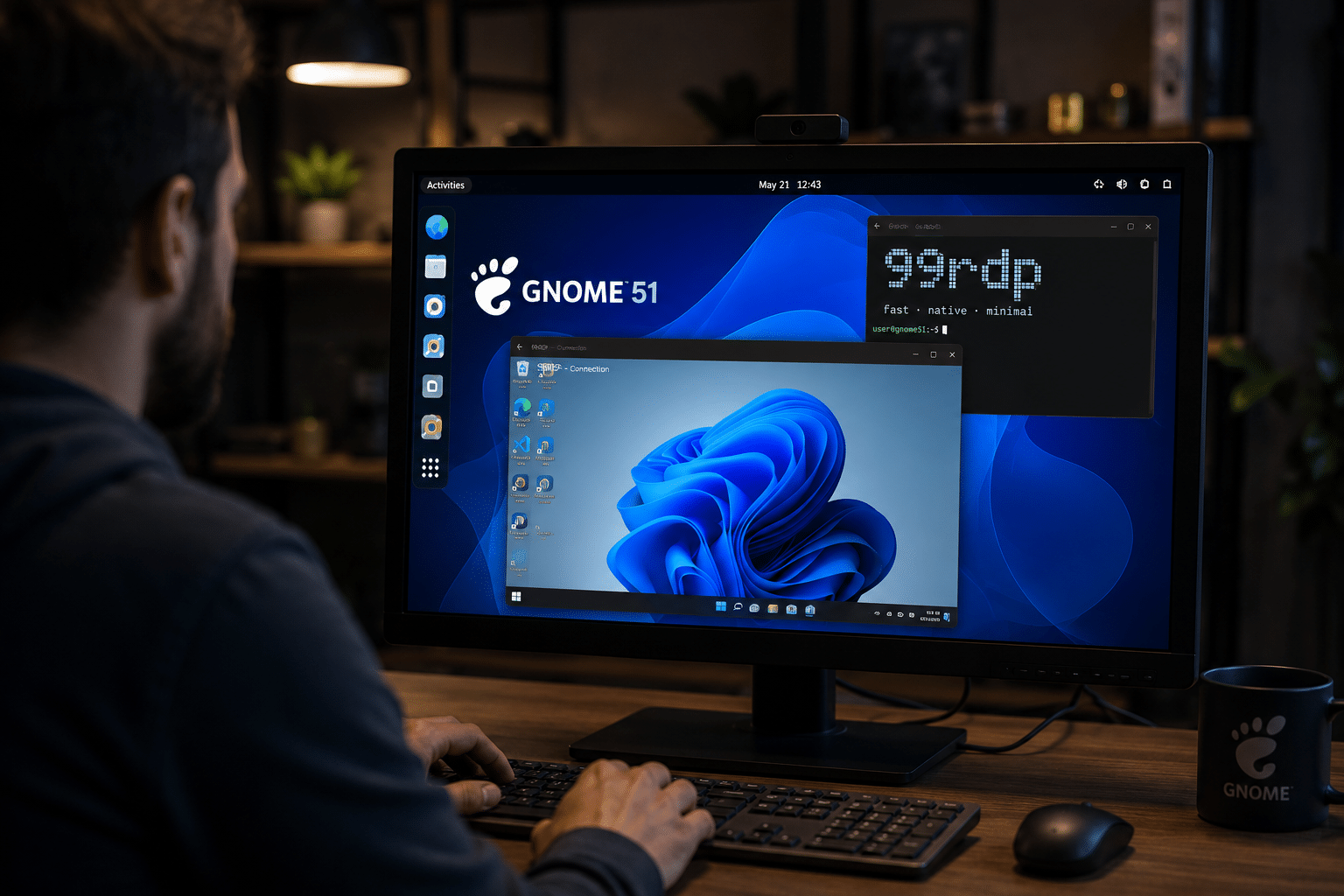
As Linux adoption accelerates, infrastructure flexibility becomes increasingly important.
Organizations frequently require:
- Rapid environment provisioning
- Remote accessibility
- Dedicated development systems
- Testing environments
- Secure desktop access
This is where 99RDP’s remote desktop solutions become highly relevant.
Developers can leverage Linux and Windows remote desktop environments to:
Create Isolated GNOME Testing Systems
Experiment with GNOME 51 Alpha without affecting production devices.
Accelerate Software Validation
Verify application compatibility across different desktop environments.
Support Distributed Teams
Enable developers to access consistent environments from anywhere.
Reduce Hardware Dependency
Perform resource-intensive tasks on remote systems rather than local machines.
Scale Development Infrastructure
Provision environments based on project requirements.
For organizations embracing remote engineering and cloud-native development, remote desktop infrastructure has become a strategic productivity tool rather than merely a convenience.
Preparing for the Stable GNOME 51 Release
The stable release is still months away.
However, organizations that prepare early often experience smoother migrations.
A practical preparation strategy includes:
Step 1: Deploy a Testing Environment
Create dedicated systems for alpha evaluation.
Step 2: Validate Applications
Test development tools, IDEs, browsers, and extensions.
Step 3: Evaluate Performance
Measure resource utilization and workflow responsiveness.
Step 4: Review Documentation
Update internal guides and deployment procedures.
Step 5: Train Teams
Introduce upcoming changes before production deployment.
Preparation significantly reduces upgrade-related disruptions.
The Bigger Picture
GNOME 51 Alpha is not merely another desktop update.
It represents the continued maturation of Linux as a professional computing platform.
The Linux desktop has undergone tremendous transformation during the past decade.
What once served primarily enthusiasts now powers:
- Enterprise engineering teams
- DevOps organizations
- Security professionals
- Cloud administrators
- AI researchers
- Software developers worldwide
GNOME’s commitment to usability, performance, and modern technologies positions it as a major contributor to this evolution.
The improvements introduced in GNOME 51 Alpha may appear incremental individually. Yet collectively, they continue shaping a desktop environment optimized for modern computing demands.
For developers, early experimentation offers an opportunity to prepare applications, influence project direction, and refine workflows ahead of the stable release.
For businesses, proactive testing minimizes migration risks and ensures infrastructure readiness.
And for organizations increasingly embracing remote development, scalable environments such as those offered by 99RDP provide the flexibility needed to evaluate, test, and adopt emerging Linux technologies efficiently.
The future of the Linux desktop is becoming increasingly intelligent, performant, and developer-centric. GNOME 51 Alpha offers one of the earliest glimpses into that future—and for developers willing to explore it today, the opportunities to learn, prepare, and innovate have already begun.
EXPLORE MORE ; Alpine Linux 3.24 Brings GNOME 50 and KDE Plasma 6.6
READ OUR BLOGS


