
Orange Pi 6 Launches with Dual 2.5GbE and 45 TOPS AI: What Developers Need to Know
The single-board computer (SBC) market has evolved dramatically over the last decade. What started as an ecosystem dominated by educational boards and DIY projects has transformed into a thriving landscape of powerful edge computing platforms capable of handling artificial intelligence, high-speed networking, multimedia processing, and enterprise-grade workloads.
The newly introduced Orange Pi 6 is a perfect example of this evolution.
Powered by the CIX P1 (CD8180) processor, featuring a 12-core ARM CPU, up to 45 TOPS of AI performance, and dual 2.5GbE networking, the Orange Pi 6 aims to bridge the gap between compact development boards and professional computing platforms.
For developers, startups, AI engineers, and businesses experimenting with edge infrastructure, the board offers capabilities that would have seemed impossible for an SBC only a few years ago.
The bigger story, however, is not merely about another ARM development board entering the market. The Orange Pi 6 represents a broader shift toward distributed computing, where AI processing, networking, and application deployment increasingly happen at the edge.
Let’s explore why developers should pay close attention to this new platform.
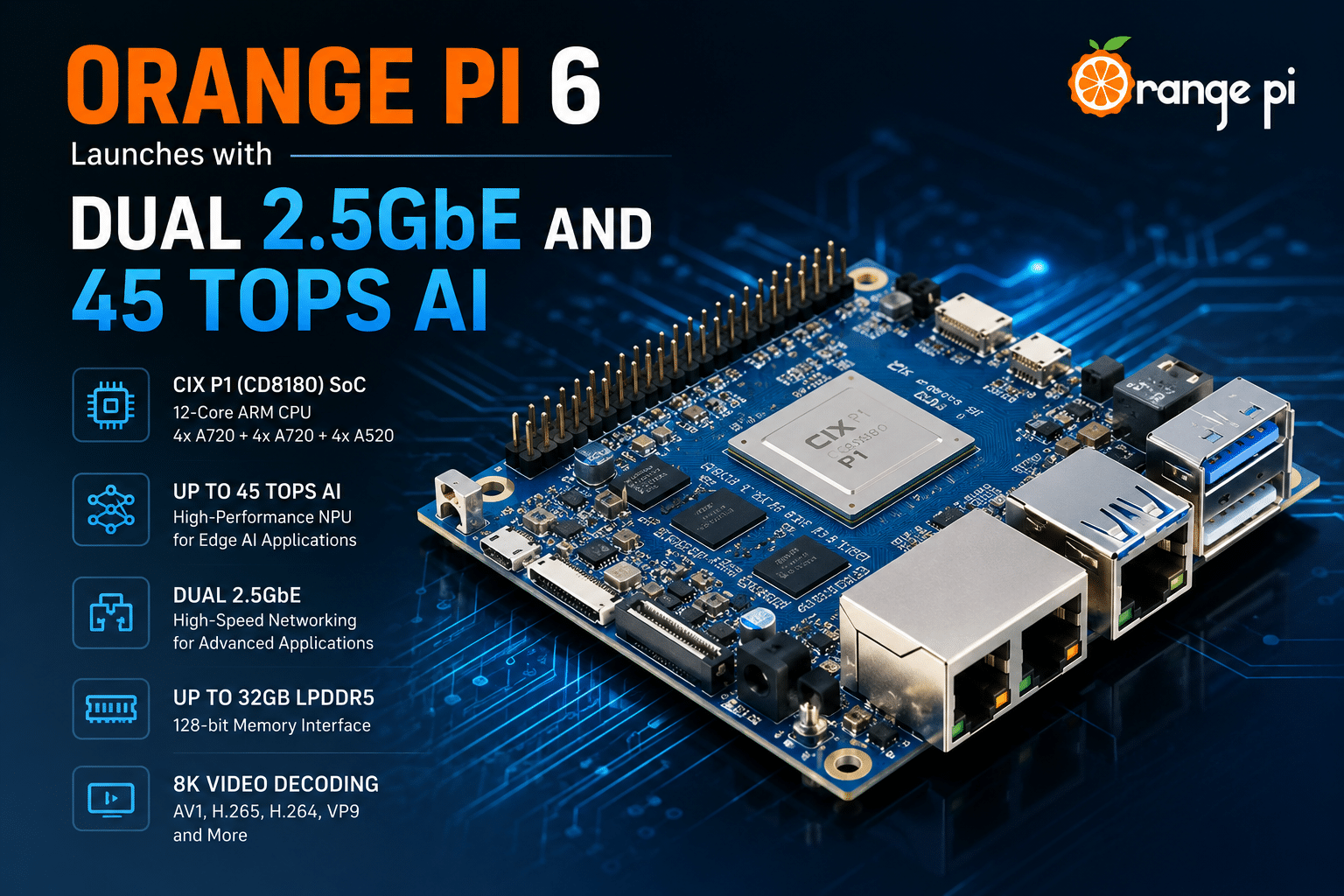
Orange Pi 6 Specifications at a Glance
Processor
The Orange Pi 6 is powered by the CIX P1 (CD8180) System-on-Chip featuring a sophisticated 12-core architecture:
Performance Cluster
- 4 × Arm Cortex-A720 cores
Mainstream Cluster
- 4 × Arm Cortex-A720 cores
Efficiency Cluster
- 4 × Arm Cortex-A520 cores
Shared Cache
- 12MB L3 Cache
This heterogeneous design allows the board to intelligently balance demanding computational tasks and energy efficiency.
AI Capabilities
Perhaps the most impressive specification is its AI acceleration capability.
AI Performance
- Up to 45 TOPS (Trillion Operations Per Second)
AI Workloads Supported
- Machine learning inference
- Object detection
- Image recognition
- Computer vision
- Large language model inferencing
- Robotics applications
- Smart surveillance systems
This level of AI performance pushes the Orange Pi 6 beyond hobbyist territory and firmly into edge AI computing.
Graphics
GPU
Arm Immortalis-G720 MC10
Supported Technologies
- Vulkan 1.3
- OpenCL 3.0
- OpenGL ES 3.2
- Hardware ray tracing
Developers building graphics-intensive applications or AI-powered visualization tools gain access to modern GPU technologies rarely seen on compact ARM boards.
Networking
Ethernet
- Dual 2.5GbE Ports
Networking has become one of the most critical requirements for modern computing environments.
The inclusion of dual high-speed Ethernet ports significantly expands deployment possibilities.
Memory
LPDDR5 RAM
- Up to 32GB
- 128-bit memory interface
High-bandwidth memory becomes particularly valuable when processing AI models, multimedia workloads, and containerized applications.
Multimedia
Video Support
- 8K Video Decoding
- H.264
- H.265
- AV1
- VP9
- MPEG-4
This makes the board suitable for digital signage, media servers, and intelligent streaming applications.
Why Orange Pi 6 Matters
The specifications alone are impressive.
However, the real significance lies in what these specifications enable.
Modern computing is increasingly moving toward three major trends:
- Artificial Intelligence
- Edge Computing
- Distributed Infrastructure
The Orange Pi 6 sits precisely at the intersection of these trends.
The Rise of Edge AI
Traditional cloud computing sends data to centralized servers for processing.
While this model works well in many scenarios, it also introduces challenges:
- Increased latency
- Higher bandwidth consumption
- Privacy concerns
- Connectivity dependencies
- Greater operational costs
Edge AI solves these problems by processing data closer to where it is generated.
Examples include:
- Industrial sensors
- Smart cameras
- Autonomous robots
- Healthcare devices
- Retail analytics systems
- Smart cities
The Orange Pi 6’s 45 TOPS AI capability positions it as a compelling platform for these applications.
Why 45 TOPS Is a Big Deal
TOPS refers to trillions of operations per second.
Higher TOPS generally translate into faster AI inferencing.
This capability enables:
Real-Time Video Analytics
Detect events and process multiple camera streams simultaneously.
Facial Recognition Systems
Perform instant identification and authentication.
Smart Manufacturing
Process machine data with minimal latency.
Predictive Maintenance
Analyze sensor data in real time.
Autonomous Robotics
Enable rapid decision-making and navigation.
Generative AI at the Edge
Deploy smaller AI models closer to users.
A few years ago, such workloads typically required dedicated GPU servers.
Today, developers can deploy many of these applications on an affordable ARM platform.
Dual 2.5GbE Is More Important Than You Think
Most SBCs continue to ship with single Gigabit Ethernet interfaces.
Orange Pi 6 goes considerably further.
Benefits of Dual 2.5GbE
Faster Data Transfer
2.5GbE delivers significantly higher throughput than traditional Gigabit networking.
Network Segmentation
Separate management traffic from production workloads.
Redundancy
Create fault-tolerant networking environments.
Load Balancing
Distribute network traffic across multiple interfaces.
Container Networking
Improve performance for microservices deployments.
Edge Gateways
Connect multiple networks efficiently.
For developers building distributed applications, networking often becomes the bottleneck.
The Orange Pi 6 directly addresses this challenge.
Building AI Clusters with Orange Pi 6
ARM clusters are becoming increasingly attractive.
Reasons include:
- Lower power consumption
- Smaller physical footprint
- Better energy efficiency
- Reduced cooling requirements
- Lower acquisition costs
Multiple Orange Pi 6 boards can theoretically form compact AI clusters capable of:
- Running Kubernetes
- Hosting inference engines
- Serving APIs
- Performing data analytics
- Training lightweight models
- Executing distributed applications
The inclusion of dual 2.5GbE networking significantly improves inter-node communication.
Perfect for Home Labs
Home labs are increasingly becoming the playground for modern developers.
The Orange Pi 6 provides an excellent platform for:
Learning Kubernetes
Build container orchestration environments.
Studying Networking
Experiment with routing and network segmentation.
AI Development
Deploy and test machine learning models.
Self-Hosting Applications
Run databases and web applications.
DevOps Training
Practice infrastructure automation.
Container Platforms
Build Docker and Podman environments.
Instead of relying solely on expensive servers, developers can now create sophisticated environments using energy-efficient ARM hardware.
ARM Computing Is Entering the Enterprise
ARM processors are no longer limited to smartphones.
Major cloud providers now offer ARM-based instances.
Organizations increasingly adopt ARM infrastructure because it provides:
Better Performance Per Watt
Lower operational costs.
Improved Energy Efficiency
Reduced power consumption.
Lower Cooling Requirements
Particularly beneficial in large deployments.
Scalability
Deploy dense computing environments.
Sustainability
Support green computing initiatives.
The Orange Pi 6 mirrors these broader enterprise trends.
Developers who gain ARM expertise today are preparing for the future of computing infrastructure.
Potential Use Cases
1. Smart Surveillance Systems
The AI accelerator can process:
- Motion detection
- Facial recognition
- License plate identification
- Anomaly detection
Processing data locally reduces cloud dependency and improves privacy.
2. Industrial Automation
The board can power:
- PLC interfaces
- Sensor aggregation
- Predictive maintenance
- Industrial dashboards
Dual Ethernet ports are particularly valuable in industrial environments.
3. Robotics
The Orange Pi 6 can support:
- Computer vision
- Navigation systems
- Object recognition
- Sensor fusion
Its compact form factor makes deployment easier.
4. Media Servers
Support for 8K decoding enables:
- Video streaming servers
- Digital signage
- Smart displays
- Multimedia kiosks
5. Network Appliances
Developers can build:
- Firewalls
- Software routers
- VPN gateways
- NAS systems
- Traffic monitoring solutions
6. Edge AI Servers
Possible applications include:
- Medical imaging
- Retail analytics
- Smart agriculture
- Intelligent transportation
- Retail automation
The Missing Piece: Accessible Development Infrastructure
Powerful hardware alone does not solve every problem.
Modern development teams are increasingly distributed.
They require:
- Secure remote access
- Centralized environments
- Collaboration tools
- Windows application support
- Scalable computing resources
Managing all these requirements entirely on local hardware can become expensive and complicated.
Why Developers Are Combining Edge Computing with Cloud Desktops
A growing number of organizations are adopting hybrid infrastructure models.
Edge Layer
Processes data locally using devices like the Orange Pi 6.
Cloud Layer
Provides centralized management and remote accessibility.
This combination delivers several advantages.
Reduced Latency
AI workloads remain close to the data source.
Better Collaboration
Teams work from anywhere.
Improved Scalability
Infrastructure can grow rapidly.
Enhanced Productivity
Developers gain consistent environments.
Lower Hardware Costs
Not every employee requires a powerful workstation.
Where 99RDP Fits into the Equation
As edge infrastructure becomes more common, remote accessibility becomes increasingly important.
This is where 99RDP’s cloud-based Windows Remote Desktop solutions become highly relevant.
Organizations using edge devices such as the Orange Pi 6 can leverage 99RDP to create efficient hybrid computing environments.
How 99RDP Complements Orange Pi 6 Deployments
Remote Management
Administrators can securely access infrastructure from anywhere.
Centralized Development
Developers can build, test, and deploy applications without depending entirely on local machines.
Windows Application Compatibility
Many enterprise workflows still rely on Windows software.
99RDP enables organizations to continue using these applications efficiently.
Cost Optimization
Businesses avoid investing in expensive workstations for every employee.
Team Collaboration
Distributed engineering teams can work on projects regardless of location.
Rapid Scalability
Cloud desktops can be provisioned quickly to meet changing business requirements.
Example Hybrid Architecture
Orange Pi 6 Edge Nodes
↓
Local AI Processing
↓
Dual 2.5GbE Networking
↓
Secure Connectivity
↓
99RDP Cloud Desktops
↓
Centralized Monitoring and Management
This approach combines low-latency processing with cloud accessibility.
Why Developers Should Pay Attention
The Orange Pi 6 checks nearly every box that modern developers care about:
Powerful 12-core ARM architecture
Up to 45 TOPS AI acceleration
Dual 2.5GbE networking
LPDDR5 high-speed memory
Compact deployment footprint
Modern graphics technologies
Excellent edge computing capabilities
Strong networking possibilities
Ideal platform for containerized workloads
Suitable for hybrid cloud architectures
Final Thoughts
The launch of the Orange Pi 6 demonstrates how rapidly the single-board computing ecosystem is evolving.
This is no longer a category limited to educational projects and hobbyist experimentation.
The Orange Pi 6 delivers enterprise-relevant features, including advanced AI acceleration, high-speed networking, modern graphics capabilities, and substantial memory bandwidth, all within a compact form factor.
For developers, it opens opportunities in edge AI, robotics, industrial automation, networking, and distributed infrastructure.
For businesses, it represents a cost-effective platform capable of supporting next-generation applications while reducing power consumption and infrastructure complexity.
And when paired with cloud desktop solutions like 99RDP, organizations gain the best of both worlds—powerful edge computing combined with secure, centralized, and remotely accessible development environments.
As artificial intelligence and edge computing continue to reshape the technology landscape, platforms like the Orange Pi 6 are poised to become foundational building blocks of the next generation of intelligent infrastructure.
EXPLORE MORE ; Why Raspberry Pi 5 Is a Game-Changer for Xibo

READ OUR BLOGS


