
Ubuntu 26.04 on CIX P1 Is a Huge Leap for ARM Linux PCs

The Linux ecosystem is entering one of the most important hardware transitions in its history. For decades, x86 processors dominated Linux desktops, workstations, and development systems. ARM chips mostly remained limited to smartphones, embedded devices, or lightweight single-board computers.
That reality is now changing rapidly.
Canonical’s Ubuntu 26.04 Concept image for the CIX P1 platform signals a major turning point for ARM Linux computing. What once looked experimental is starting to become practical, scalable, and enterprise-ready.
The Ubuntu Concept release for CIX P1 introduces official Ubuntu support for a powerful Armv9 AI-focused platform using a Linux 7.0-based kernel, upstream-first drivers, and ACPI integration.
This is not just another Linux hardware compatibility update.
It represents a broader industry shift involving:
- ARM desktop computing
- AI acceleration
- cloud-native infrastructure
- energy-efficient systems
- edge computing
- remote development workflows
- open-source hardware standardization
For developers, cloud engineers, Linux enthusiasts, and remote infrastructure teams, Ubuntu 26.04 on CIX P1 may become one of the most significant Linux developments of 2026.
What Is the CIX P1 Platform?
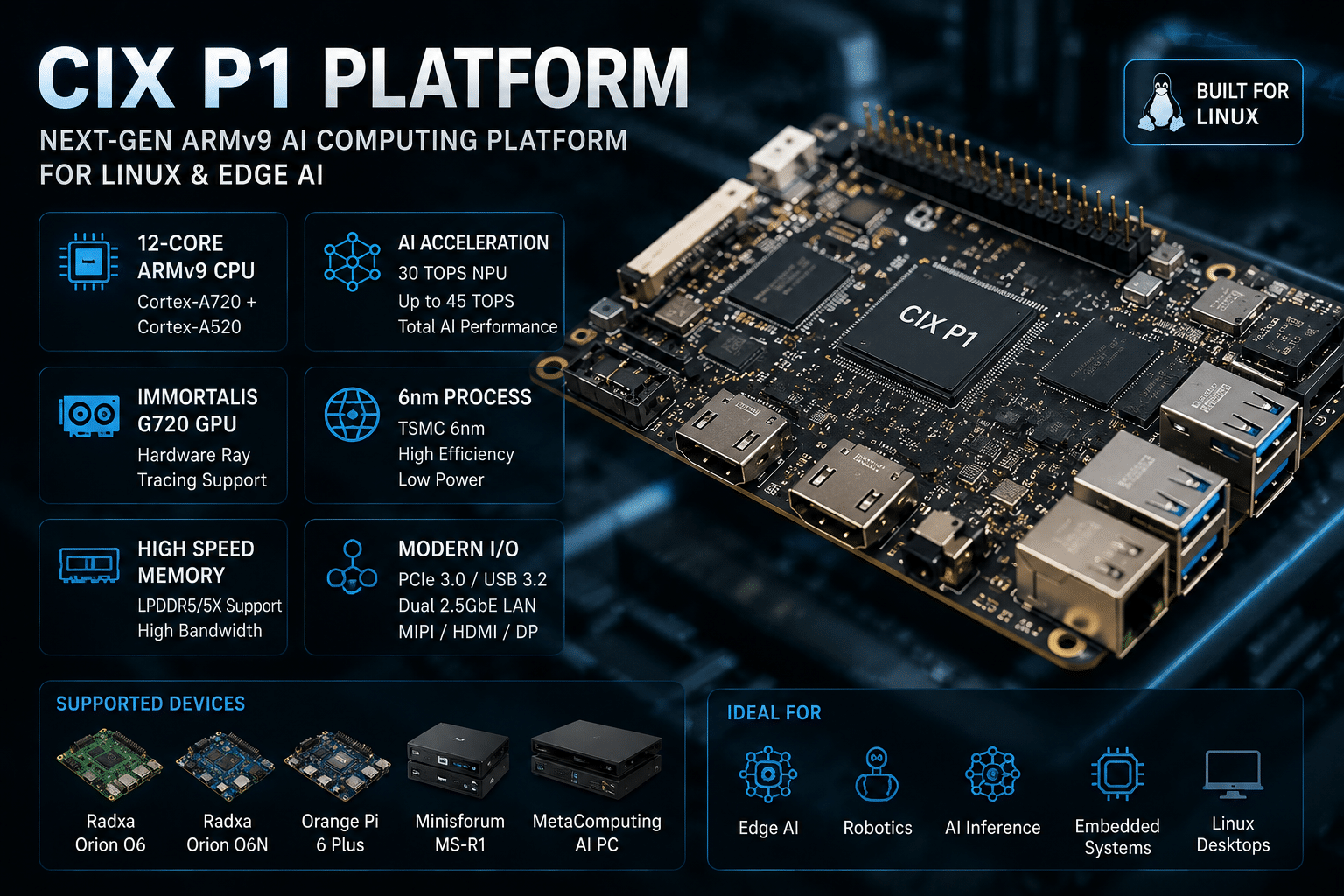
The CIX P1 is a next-generation Armv9 processor platform focused on AI workloads, high-efficiency computing, and modern Linux support.
According to Canonical and industry reports, the platform includes:
- 12-core Armv9 CPU architecture
- Cortex-A720 performance cores
- Cortex-A520 efficiency cores
- Arm Immortalis G720 GPU
- Hardware ray tracing support
- 30 TOPS dedicated NPU
- Up to 45 TOPS combined AI compute capability
- TSMC 6nm fabrication process
This places the CIX P1 far above entry-level ARM boards traditionally associated with Linux experimentation.
The processor already powers several emerging ARM Linux systems, including:
- Radxa Orion O6
- Radxa Orion O6N
- Orange Pi 6 Plus
- Minisforum MS-R1
- MetaComputing AI PC
These devices aim to deliver desktop-class Linux experiences while maintaining ARM’s efficiency advantages.
Why Ubuntu Support Is So Important
Hardware specifications alone do not determine whether a platform succeeds.
Software support matters even more.
Historically, ARM Linux ecosystems suffered from severe fragmentation.
Common issues included:
- vendor-specific kernels
- inconsistent boot systems
- limited upstream drivers
- poor long-term maintenance
- incompatible firmware
- device-specific patches
These problems prevented ARM systems from becoming true Linux desktop alternatives.
Canonical’s Ubuntu Concept strategy changes this dramatically.
Instead of relying entirely on custom Device Tree configurations, Ubuntu’s CIX P1 support uses ACPI-based hardware discovery similar to x86 systems.
That may sound technical, but it has enormous implications.
ACPI Could Finally Standardize ARM Linux
For years, ARM Linux devices depended heavily on Device Trees.
A Device Tree manually describes hardware components to Linux. Every board often needs:
- separate kernel configurations
- custom firmware handling
- unique boot logic
- board-specific maintenance
This creates fragmentation.
By contrast, x86 systems use ACPI, allowing hardware to self-describe dynamically during boot.
Canonical is now pushing ARM Linux toward that same standardized model.
Benefits include:
| Traditional ARM Linux | Ubuntu ACPI Approach |
|---|---|
| Device-specific configuration | Universal hardware discovery |
| Custom boot setups | Standardized boot process |
| Fragmented support | Easier compatibility |
| Vendor dependency | Better upstream support |
| Difficult maintenance | Simplified updates |
This shift could become one of the biggest ARM Linux breakthroughs of the decade.
Why ARM Linux Desktops Are Finally Becoming Real
For years, ARM Linux desktops were considered niche experiments.
Performance limitations, software compatibility issues, and weak driver support prevented serious adoption.
Now multiple trends are changing that:
- Armv9 performance improvements
- AI acceleration hardware
- better GPU support
- improved Linux compatibility
- cloud-native workflows
- containerized development
- remote-first computing
The Linux desktop itself is evolving.
Modern Linux users increasingly prioritize:
- power efficiency
- silent systems
- small form factors
- remote accessibility
- virtualization
- AI compatibility
ARM platforms are extremely well suited for these priorities.
AI Acceleration Changes the Entire Market
One of the most important aspects of the CIX P1 is its integrated AI acceleration.
The chip includes a dedicated 30 TOPS NPU.
This matters because AI workloads are rapidly becoming part of everyday computing.
Developers increasingly use AI for:
- local inference
- code generation
- computer vision
- machine learning
- automation
- voice processing
- edge analytics
Traditional desktop CPUs are often inefficient for these tasks.
Dedicated NPUs improve:
- AI performance
- energy efficiency
- inference speed
- local processing capability
This allows Linux systems to handle modern AI workloads without depending entirely on cloud APIs.
Ubuntu 26.04 Reflects Linux’s New Direction
Canonical’s investment in CIX P1 support reflects broader changes happening across Linux.
Linux distributions increasingly focus on:
- ARM64 support
- edge computing
- immutable infrastructure
- cloud-native systems
- AI compatibility
- upstream driver development
Canonical’s Ubuntu Core 26 strategy reinforces this direction through:
- transactional updates
- secure edge deployments
- ARM64 live patching
- embedded AI infrastructure
The Linux ecosystem is clearly preparing for a future where ARM plays a much larger role.
The Rise of Edge Computing Is Accelerating ARM Adoption
Edge computing is one of the biggest reasons ARM hardware is growing rapidly.
Instead of processing everything inside centralized data centers, organizations increasingly deploy computing resources closer to users and devices.
Benefits include:
- lower latency
- better privacy
- reduced bandwidth usage
- offline functionality
- faster real-time processing
ARM systems excel in edge environments because they offer:
- lower power consumption
- smaller thermal requirements
- compact deployment options
- strong performance-per-watt ratios
The CIX P1 fits perfectly into this emerging infrastructure model.
Why Developers Should Pay Attention
Modern software development increasingly depends on ARM compatibility.
Developers now frequently build applications for:
- Android
- ARM cloud servers
- IoT systems
- edge AI devices
- ARM containers
- mobile infrastructure
Having a desktop-class ARM Linux environment improves:
- testing workflows
- cross-platform development
- container validation
- architecture compatibility
Ubuntu 26.04 on CIX P1 makes this easier.
The platform reportedly delivers performance significantly beyond Raspberry Pi-class devices while competing with entry-level x86 mini PCs in several workloads.
That creates new opportunities for ARM-native Linux development.
Open-Source Drivers Are a Major Win
One of the biggest historical weaknesses of ARM Linux hardware was proprietary software.
Many ARM devices depended on:
- closed GPU drivers
- vendor kernels
- unsupported firmware
- abandoned software stacks
Canonical’s CIX P1 effort focuses heavily on upstream-first open-source support.
This approach improves:
- long-term reliability
- kernel compatibility
- security maintenance
- community development
- ecosystem sustainability
Open-source support is critical for serious Linux adoption.
The Linux Hardware Ecosystem Is Expanding Rapidly
The Linux hardware market is becoming far more diverse.
We are now seeing serious ARM competition from:
- Qualcomm Snapdragon X Elite
- Apple Silicon Linux projects
- Ampere ARM servers
- NVIDIA Grace platforms
- emerging AI-focused ARM chips
Ubuntu’s CIX P1 support adds another important option to this growing ecosystem.
Competition benefits Linux users because it drives:
- better drivers
- improved software compatibility
- more affordable hardware
- faster innovation
Why Cloud Infrastructure Is Also Moving Toward ARM
ARM adoption is not limited to local devices.
Cloud infrastructure providers increasingly deploy ARM servers because they offer:
- higher energy efficiency
- lower operating costs
- improved scalability
- better density
- reduced thermal output
Major cloud providers already support ARM instances for:
- Kubernetes clusters
- Docker workloads
- CI/CD pipelines
- scalable backend services
This means developers increasingly need ARM-native environments for testing and deployment.
Ubuntu 26.04 on CIX P1 helps bridge desktop and cloud ARM workflows.
How 99RDP Fits Into Modern ARM Linux Workflows
As ARM Linux ecosystems mature, remote computing becomes even more important.
Developers increasingly use cloud-hosted Linux systems for:
- software development
- DevOps operations
- browser automation
- AI experimentation
- remote testing
- cybersecurity labs
- container orchestration
This is where services like 99RDP become highly relevant.
Cloud desktop infrastructure allows developers to:
- access Linux environments remotely
- scale workloads dynamically
- test multiple platforms
- run distributed workflows
- manage development environments from anywhere
The combination of ARM-native Linux systems and scalable cloud workstations creates highly flexible development pipelines.
For teams adopting ARM workflows, remote infrastructure becomes a major advantage.
Why ARM Systems Are Better for Energy Efficiency
Power efficiency is becoming one of the biggest priorities in computing.
Rising electricity costs and growing AI workloads are increasing demand for systems that deliver better performance-per-watt.
ARM processors excel here.
Advantages include:
- lower idle power draw
- reduced cooling requirements
- quieter systems
- smaller form factors
- improved thermal efficiency
These benefits matter for:
- home labs
- remote offices
- edge deployments
- always-on servers
- portable development environments
The CIX P1’s 6nm manufacturing process further improves efficiency.
The Raspberry Pi Era Is Evolving
Raspberry Pi helped popularize ARM Linux, but modern workloads demand significantly more power.
Today developers increasingly need:
- advanced GPUs
- AI acceleration
- virtualization support
- multi-core performance
- PCIe connectivity
- desktop-class responsiveness
Platforms like CIX P1 target this next generation of ARM Linux users.
Canonical itself noted that the CIX P1 significantly outperforms Raspberry Pi 5-class systems.
This positions it closer to real workstation-class Linux hardware.
Remote Development Is Changing Hardware Priorities
Modern developers increasingly work through:
- SSH
- remote desktops
- cloud IDEs
- containers
- browser-based development platforms
instead of relying entirely on local machines.
This changes how hardware is evaluated.
Efficiency, flexibility, and scalability often matter more than raw desktop power alone.
ARM systems fit these remote-first workflows extremely well.
Community Excitement Around ARM Linux Keeps Growing
Linux communities are increasingly optimistic about ARM desktop adoption.
Reddit discussions surrounding Ubuntu’s CIX P1 support highlighted excitement around:
- standardized ARM booting
- ACPI support
- upstream Linux compatibility
- broader hardware adoption
This enthusiasm reflects growing confidence that ARM Linux desktops are finally becoming practical for mainstream development workflows.
Ubuntu Concept Images Are a Smart Strategy
Canonical’s “Ubuntu Concept” branding is strategically important.
Instead of waiting years for fully polished releases, Canonical encourages:
- rapid testing
- early feedback
- community experimentation
- upstream contribution
This accelerates Linux hardware maturity dramatically faster than traditional release cycles.
It also allows developers to begin optimizing ARM workflows sooner.
The Future of Linux Is Becoming More Diverse
One of the most exciting aspects of Ubuntu’s CIX P1 support is what it represents philosophically.
Linux is no longer tied to one hardware architecture.
The ecosystem is becoming:
- more portable
- more efficient
- more modular
- more AI-focused
- more cloud-native
This diversification strengthens Linux overall.
Final Thoughts
Ubuntu 26.04 on CIX P1 is far more than a niche hardware experiment.
It represents one of the clearest signs yet that ARM Linux computing is entering a new era.
The combination of:
- Armv9 performance
- AI acceleration
- Ubuntu support
- ACPI standardization
- upstream drivers
- cloud-native compatibility
creates a compelling vision for the future of Linux infrastructure.
For developers, system administrators, and Linux enthusiasts, this transition could reshape how Linux systems are built, deployed, and managed over the next decade.
And when paired with scalable remote infrastructure platforms like 99RDP, ARM-native Linux workflows become even more powerful, flexible, and accessible.
Linux is no longer simply adapting to ARM hardware.
It is beginning to evolve around it.
EXPLORE MORE ; GNU Linux-libre 7.0 vs Standard Linux
READ OUR BLOGS


