
Why UmbrelOS is the Future of Personal Cloud

The way we store, access, and control data is undergoing a fundamental shift. For over a decade, cloud computing has been dominated by centralized giants—Google Drive, AWS, Dropbox—offering convenience at the cost of privacy, ownership, and long-term cost control.
Now, a new paradigm is emerging: personal cloud infrastructure.
At the forefront of this movement is UmbrelOS, a Debian-based, self-hosted cloud operating system that combines modern UI design, containerized architecture, and an expanding app ecosystem into a unified platform.
UmbrelOS is not just another Linux distro—it represents a re-architecture of personal computing, where users regain control over their data, services, and digital identity.
Understanding UmbrelOS: Architecture & Design Philosophy
UmbrelOS is built on top of Debian Linux, leveraging its stability while abstracting complexity through a web-based graphical interface.
Core Architectural Components
- Containerized Application Layer
- Uses Docker for app deployment
- Ensures isolation, portability, and easy updates
- Eliminates dependency conflicts
- Web-Based Dashboard
- Fully browser-accessible UI
- No need for SSH-heavy workflows
- Simplified app management
- App Store Ecosystem
- 300+ applications (and growing)
- One-click install/uninstall
- Includes productivity, media, finance, and AI tools
- Secure Networking Stack
- Local-first architecture
- Optional remote access
- Encrypted connections
This layered approach transforms UmbrelOS into something closer to a “server OS for humans” rather than a traditional sysadmin tool.
The Shift Toward Personal Cloud: Market Drivers
UmbrelOS is gaining traction not by coincidence, but because it aligns with macro-level industry trends:
1. Privacy & Data Sovereignty
Users are increasingly aware that:
- Big Tech platforms monetize user data
- Data breaches are rising
- Regulatory frameworks (GDPR, etc.) are tightening
UmbrelOS solves this by: Keeping data local and user-owned
2. Subscription Fatigue
Modern SaaS ecosystems rely heavily on recurring payments:
- Cloud storage subscriptions
- Streaming platforms
- Productivity tools
UmbrelOS enables: One-time hardware investment → long-term cost savings
3. Edge Computing & Decentralization
The industry is moving away from centralized infrastructure toward:
- Edge computing
- Distributed systems
- Local-first applications
UmbrelOS fits perfectly into this ecosystem by acting as a personal edge server.
Key Features That Make UmbrelOS Stand Out
1. Consumer-Grade User Experience
Unlike traditional self-hosting platforms, UmbrelOS prioritizes UX:
- Clean UI comparable to modern SaaS apps
- Minimal learning curve
- Visual app management
This is a critical factor in mainstream adoption.
2. Rich App Ecosystem
UmbrelOS transforms into a multi-functional cloud through apps:
🔹 Productivity
- Nextcloud (file sync & collaboration)
- Vaultwarden (password manager)
🔹 Media
- Jellyfin (self-hosted Netflix alternative)
- Photo management apps
🔹 AI & Development
- Local AI models (via tools like Ollama)
- Developer utilities
🔹 Smart Home
- Home Assistant integration
This modularity makes UmbrelOS adaptable to multiple use cases.
3. Security by Design
UmbrelOS incorporates:
- Encrypted storage and backups
- App sandboxing via containers
- Minimal exposure to external networks
Compared to public cloud platforms, attack surfaces are significantly reduced.
4. Seamless Updates & Maintenance
Managing Linux systems often requires manual intervention.
UmbrelOS simplifies this:
- One-click updates
- Automatic dependency handling
- Stable release cycles
Limitations: Where UmbrelOS Needs Support
Despite its strengths, UmbrelOS is not without constraints:
Hardware Dependency
- Performance tied to local CPU/RAM
- Limited scalability on Raspberry Pi or old PCs
Network Constraints
- Requires stable internet for remote access
- Bandwidth bottlenecks for media streaming
Always-On Requirement
- Needs continuous uptime
- Power consumption considerations
Unlocking Full Potential with Remote Infrastructure (99RDP Strategy)
To overcome these limitations, advanced users are increasingly combining UmbrelOS with remote desktop infrastructure like 99RDP.
This hybrid approach bridges the gap between: Self-hosting freedom
Enterprise-grade performance
1. Deploy UmbrelOS on High-Performance Virtual Machines
Instead of relying solely on local hardware:
- Install UmbrelOS on a remote VM
- Access via RDP from any device
Benefits:
- No hardware constraints
- Always-on availability
- Reduced maintenance overhead
2. Scale Resources Dynamically
UmbrelOS apps such as:
- AI inference engines
- Media streaming servers
- Automation pipelines
require significant compute power.
Using 99RDP:
- Increase RAM/CPU as needed
- Handle multi-user workloads
- Maintain consistent performance
3. Global Accessibility
With remote deployment:
- Access your personal cloud from anywhere
- Collaborate across locations
- Enable remote development environments
4. Enhanced Security Layers
Combining UmbrelOS + 99RDP provides:
- Controlled access environments
- Reduced exposure of local networks
- Professional-grade hosting infrastructure
5. Professional Use Cases
This integration opens doors for:
Developers
- Host dev environments
- Run CI/CD pipelines
Content Creators
- Stream media libraries
- Manage large assets
AI Enthusiasts
- Run local AI models
- Experiment with LLMs
Small Businesses
- Replace SaaS tools
- Maintain internal cloud systems
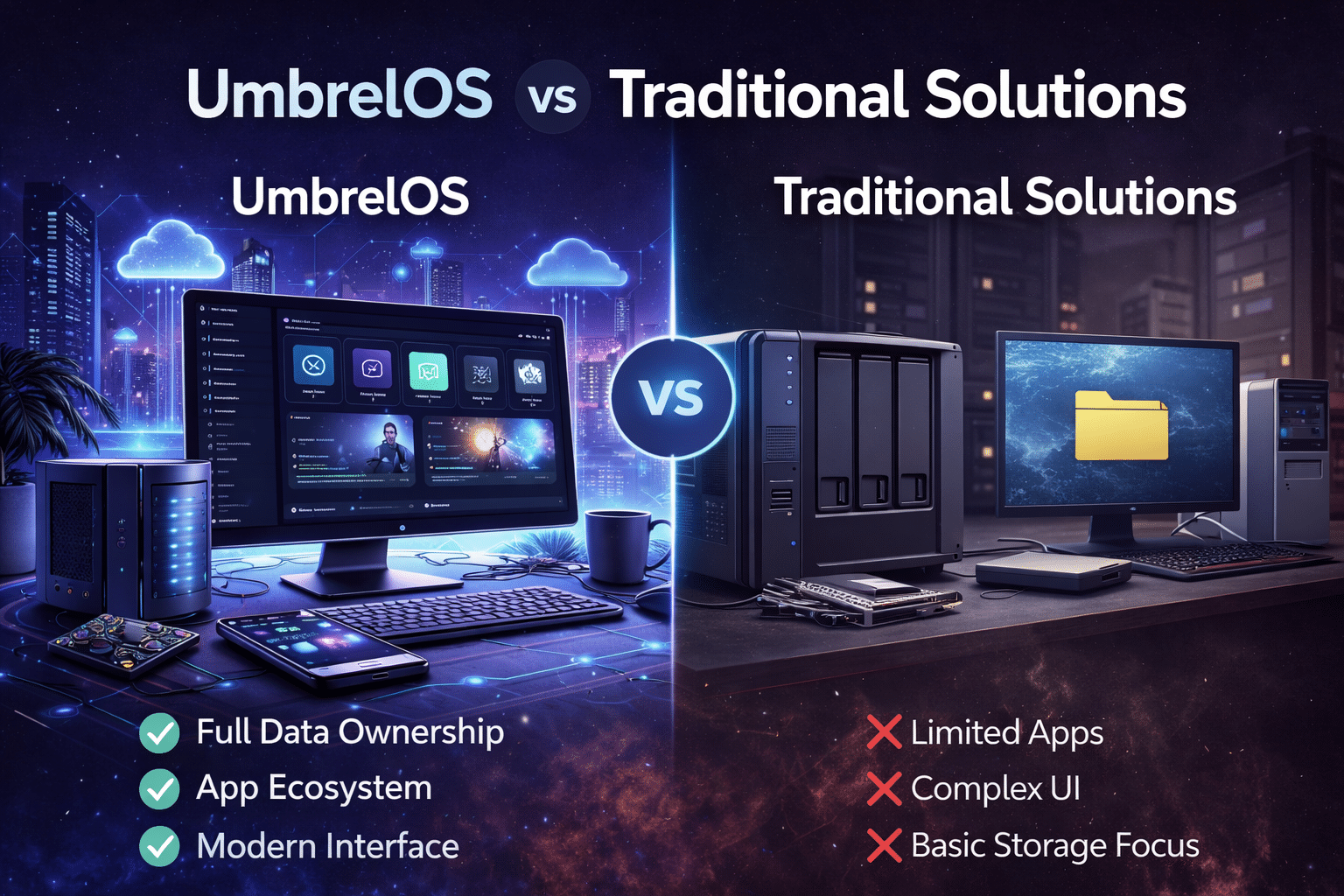
UmbrelOS vs Traditional Solutions
| Feature | UmbrelOS | Traditional NAS | Public Cloud |
|---|---|---|---|
| Data Ownership | Full | Full | Limited |
| Ease of Use | High | Medium | High |
| Cost Model | One-time | One-time | Subscription |
| App Ecosystem | Extensive | Limited | Extensive |
| Privacy | High | High | Low |
UmbrelOS strikes a balance between usability and control.
Why UmbrelOS Will Dominate
UmbrelOS is positioned at the intersection of multiple high-growth trends:
1. Rise of Self-Hosting Communities
Developers and privacy advocates are driving adoption.
2. Growth of AI at the Edge
Running AI locally will become standard.
3. Decentralized Internet (Web3 Influence)
Personal nodes and self-hosted services will play a major role.
4. Hardware Advancements
Affordable mini PCs and ARM devices will boost adoption.
Final Thoughts
UmbrelOS is not just a product—it’s a philosophy shift.
It challenges the assumption that:
Cloud must be centralized
Data must be outsourced
Users must depend on corporations
Instead, it offers:
- Ownership
- Flexibility
- Transparency
However, to truly unlock its potential: Pairing it with scalable infrastructure like 99RDP creates a powerful hybrid model.
EXPLORE MORE ; AerynOS 2026.03 vs Traditional Distros
READ OUR BLOGS


