
From NAT Traversal to Secure Tunnels: Inside Tailscale’s New Tailcat Tool

Modern infrastructure has a connectivity problem.
Not because networks are unavailable. In fact, we have more connected devices, cloud servers, containers, virtual machines, and edge systems than ever before. The real problem is that connecting two machines securely can still involve an uncomfortable amount of infrastructure.
You may need to configure firewall rules. Open ports. Manage public IP addresses. Exchange SSH keys. Configure a VPN. Set up access policies. Deal with NAT. Or deploy a reverse proxy.
All of that can make sense for permanent infrastructure.
But what happens when you simply want to connect two machines for ten minutes?
Perhaps you need to copy files from a laptop to a remote sandbox. Maybe an AI coding agent needs temporary access to a test machine. Perhaps you have two servers behind different NATs and want to create a quick encrypted connection between them.
This is the problem that Tailcat, a new open-source tool from Tailscale, is designed to address.
Tailcat takes key components of Tailscale’s networking technology—including WireGuard-based encryption, NAT traversal, and DERP relay fallback—and packages them into a lightweight, netcat-inspired command-line tool. The notable part is what it leaves behind: there are no accounts, no login flows, no tailnets, no traditional IP address management, and no centralized control plane.
The result is an intriguing new approach to machine-to-machine connectivity.
Tailcat is not trying to replace Tailscale. It is not trying to replace enterprise VPNs. And it is certainly not a complete network management platform.
Instead, it focuses on a deceptively simple question:
What if securely connecting two machines did not require building a network around them?
That idea has implications far beyond a convenient command-line utility. It reflects the changing nature of infrastructure itself.
As cloud computing, AI agents, ephemeral workloads, remote development, and distributed systems continue to grow, connectivity increasingly needs to be as flexible as compute.
Let’s take a deeper look inside Tailcat, understand how NAT traversal and secure tunnels work, explore the role of DERP relays, and examine why lightweight networking tools may become increasingly important for modern Linux and cloud infrastructure.
What Is Tailcat?
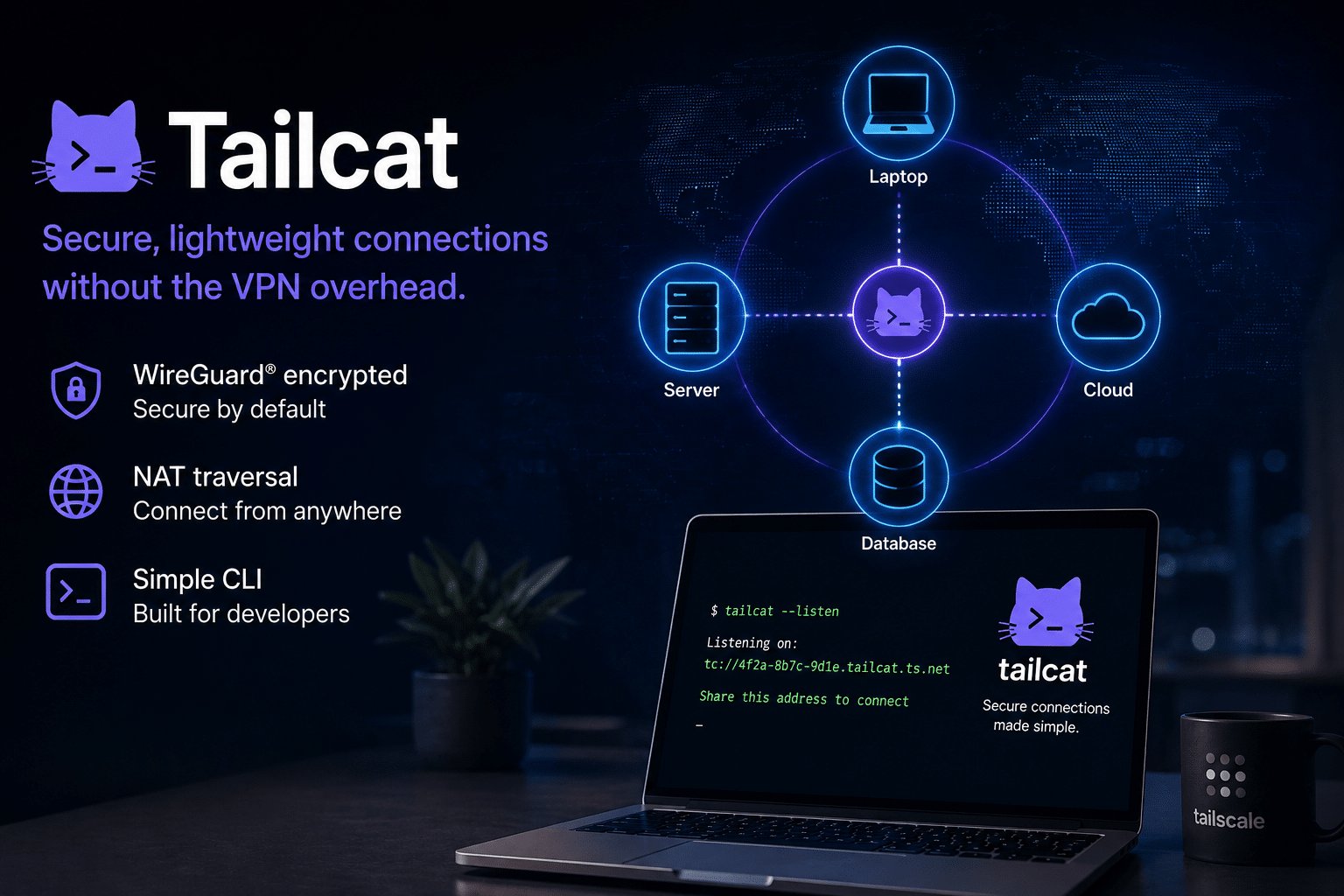
Tailcat is an open-source Go package and command-line tool built using components of Tailscale’s open-source networking data plane.
Tailscale describes Tailcat as essentially a way to use parts of its networking technology without using the broader Tailscale control plane. At its core, Tailcat combines:
- WireGuard encryption
- NAT traversal
- DERP rendezvous and relay fallback
- Public-key cryptography
- Userspace networking
- A netcat-like command-line workflow
The simplest way to understand it is this:
Tailcat helps two machines establish an encrypted connection even when they live on different networks and may sit behind NATs or firewalls.
Unlike a traditional VPN workflow, however, Tailcat intentionally removes many persistent networking concepts.
According to Tailscale, Tailcat has no:
- User accounts
- Passwords
- SSO requirements
- Tailnets
- Users
- Administrators
- Administrative controls
- Centralized control plane
- User-visible IP addresses
Instead, a machine running Tailcat can generate a connection address that another machine uses to establish a secure connection.
This makes Tailcat particularly interesting for temporary and narrowly scoped connectivity.
Why Connecting Machines Is Still More Difficult Than It Should Be
Before understanding why Tailcat matters, it helps to understand the problem it addresses.
Imagine two computers:
- A developer’s laptop at home
- A temporary Linux server running in a cloud environment
The developer wants to connect them.
That sounds easy.
But networking reality can quickly become complicated.
The laptop may sit behind a home router using Network Address Translation.
The cloud server may sit behind firewall rules.
Neither system may expose a service to the public internet.
Even if one system has a public IP address, opening a port creates additional security considerations.
Traditional solutions might include:
SSH
SSH is excellent for remote administration, but it typically requires:
- Reachable server infrastructure
- SSH service configuration
- Authentication management
- Firewall access
Traditional VPN
A VPN can securely connect machines, but it often introduces:
- User management
- Authentication
- Network configuration
- Routing
- Access policies
- Ongoing administration
Port Forwarding
Port forwarding can expose a local service externally, but it may require:
- Router configuration
- Public IP addresses
- Firewall changes
- Additional security hardening
Reverse Proxies
Reverse proxies work well for web services but introduce another infrastructure component to deploy and manage.
Cloud-Based File Sharing
Uploading files to an intermediary service can work, but it adds:
- External dependencies
- Storage copies
- Credential management
- Additional transfer steps
None of these solutions are inherently bad.
The issue is proportionality.
If you need permanent infrastructure, permanent networking tools make sense.
But if you simply want to send a file between two machines right now, building a persistent network relationship can feel excessive.
Tailcat aims to fill that gap.
Tailcat Is Inspired by the Simplicity of Netcat
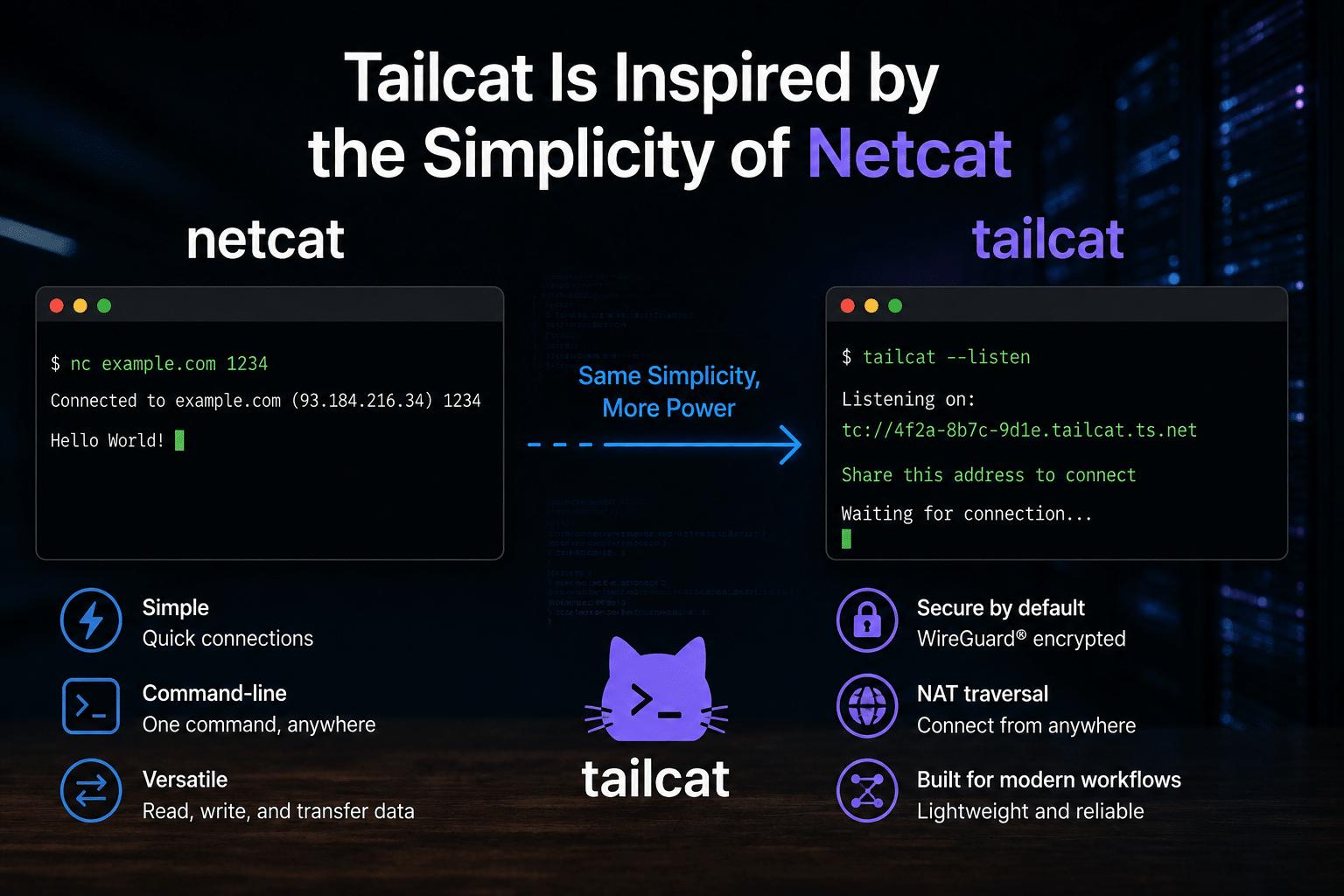
Netcat has long been one of the most useful tools in a Linux administrator’s toolkit.
At its simplest, it allows users to create and interact with network connections from the command line.
Netcat’s appeal comes from its simplicity.
You can pipe data into it.
You can receive data from it.
You can use it for testing.
You can experiment with networking.
Tailcat takes inspiration from this model.
But instead of assuming you already have a straightforward network path between machines, Tailcat adds modern connectivity technology underneath the simple workflow.
Conceptually:
Traditional netcat:
Machine A → Network → Machine B

Tailcat:
Machine A → NAT Traversal + WireGuard Encryption → Machine B
                       ↓
                 DERP Fallback
This is where Tailcat becomes more than simply another command-line networking utility.
The complexity moves underneath the user experience.
Instead of manually solving the networking problem first, Tailcat attempts to solve it automatically.
Understanding NAT: The Invisible Barrier Between Devices
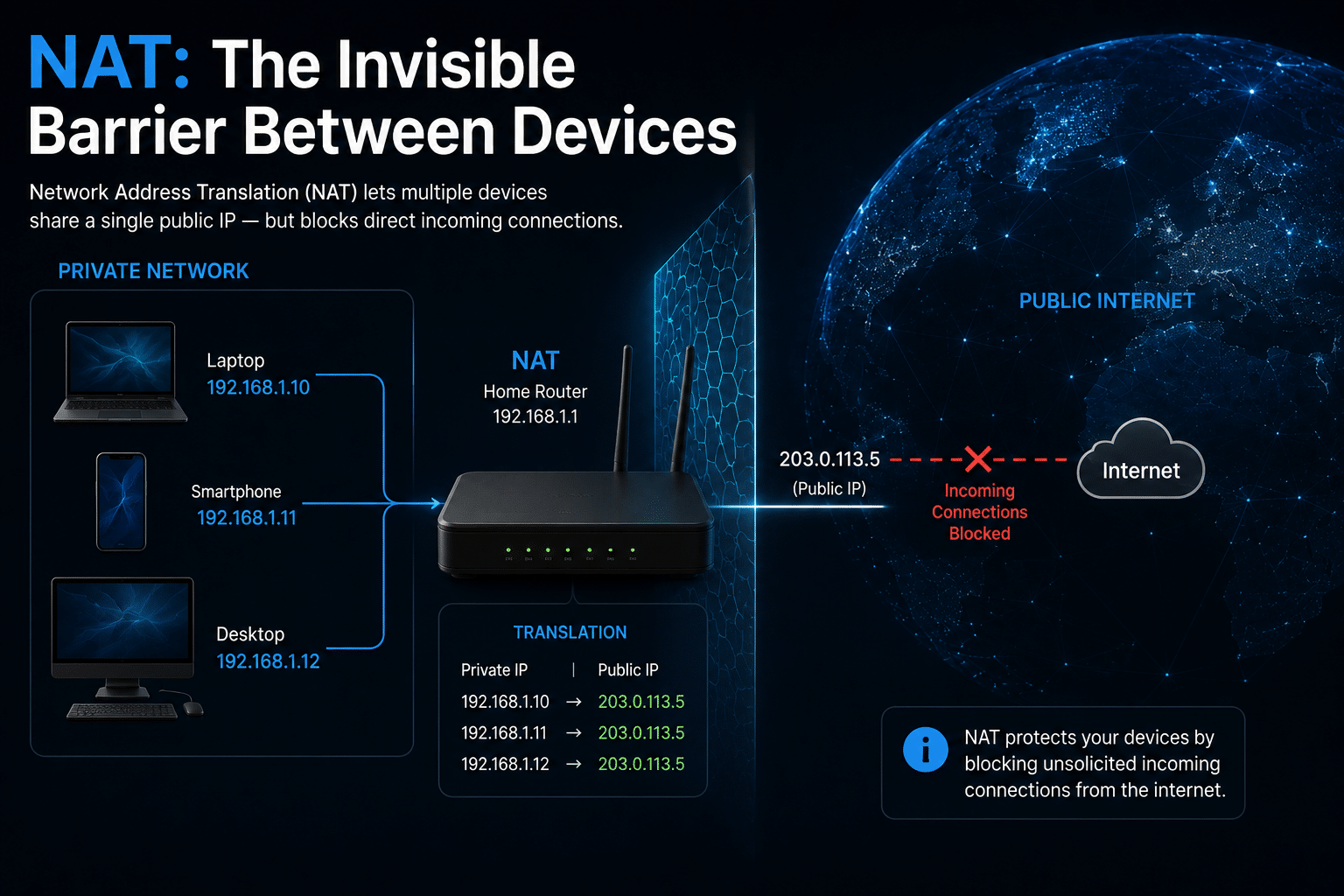
One of the biggest obstacles to direct connectivity is NAT.
NAT stands for Network Address Translation.
Most home and office networks use it.
A typical setup might look like this:
Internet
    |
Public IP Address
    |
Home Router
    |
---------------------
|        |          |
Laptop   Phone     Desktop
The router has a public address.
The devices behind it use private addresses.
For example:
- Laptop: 192.168.1.10
- Desktop: 192.168.1.11
- Phone: 192.168.1.12
These private addresses are not directly reachable from the public internet.
The router translates connections between the internal devices and the external network.
This architecture is useful.
It conserves IPv4 addresses and provides a natural barrier between internal devices and unsolicited incoming connections.
But it creates a challenge.
Suppose two laptops are both behind different NAT routers.
Neither laptop has a publicly reachable address.
How do they connect directly?
That is where NAT traversal techniques become important.
NAT Traversal: Making Direct Connections Possible
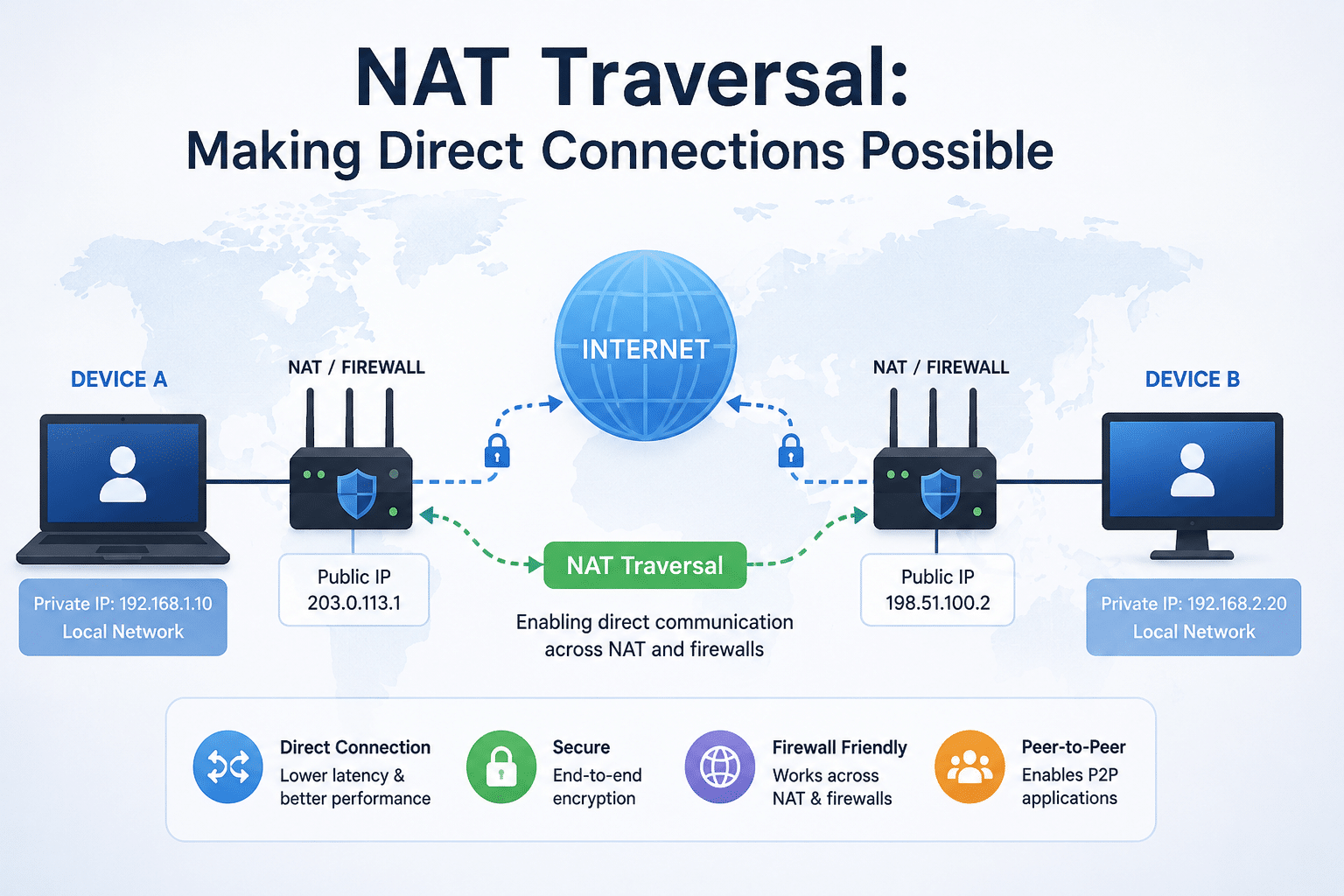
NAT traversal is a collection of techniques designed to help devices communicate directly despite NAT boundaries.
The basic concept is deceptively clever.
If two devices can discover how the outside world sees their network connections, they may be able to coordinate simultaneous outbound communication.
The NAT devices may then allow return traffic through the mappings they created.
In practice, NAT traversal is considerably more complicated.
Different routers behave differently.
Some NAT implementations are relatively friendly to peer-to-peer communication.
Others are much more restrictive.
Tailscale has invested heavily in NAT traversal technology and explains that its architecture prioritizes direct peer-to-peer connections whenever possible, using relays as fallback infrastructure when direct connectivity cannot be established. Tailscale has reported direct connection success rates well above 90% in typical conditions, although success naturally depends on network characteristics and restrictions.
Tailcat benefits from this same underlying networking experience.
When possible, it attempts to establish a direct connection between peers.
This matters because direct connections can provide:
- Lower latency
- Better throughput
- Reduced intermediary dependency
- More efficient data transfer
However, NAT traversal cannot solve every situation.
And this is where DERP enters the picture.
What Happens When Direct Connections Fail?
Not every network allows peer-to-peer connectivity.
Some environments create particularly difficult networking conditions.
Examples include:
- Symmetric NAT
- Multiple layers of NAT
- Carrier-grade NAT
- Strict enterprise firewalls
- Networks that block UDP
- Security appliances that restrict peer-to-peer traffic
In these environments, NAT traversal attempts may fail.
A reliable connectivity system needs a fallback.
Tailscale’s answer is DERP.
DERP stands for Detour Encrypted Routing Protocol.
It acts as relay infrastructure when a direct peer-to-peer connection cannot be established.
The key idea is important:
The relay helps transport encrypted traffic, but it is not intended to replace direct connectivity when a direct path is available.
Tailcat follows this philosophy.
The connection process can use relay infrastructure to bootstrap communication and fall back to relayed connectivity when NAT traversal cannot establish a direct path.
This layered approach creates a practical networking model:
Step 1: Attempt connection

        ↓

Step 2: Exchange connectivity information

        ↓

Step 3: Attempt direct NAT traversal

        ↓

Success?
   /          \
 Yes           No
 |             |
Direct       DERP Relay
Encrypted    Encrypted
Connection   Connection
The goal is not to force every connection through centralized infrastructure.
The goal is to use the best available path.
How Tailcat Works Behind the Scenes
Tailcat intentionally keeps the user experience simple, but several interesting technical steps occur behind the scenes.
According to Tailscale’s technical explanation, the server side begins by generating a keypair.
The key can be ephemeral or reusable.
Tailcat then selects DERP infrastructure, either from a specified server or from an automatically selected available relay.
Next, it generates a Tailcat address.
This address packages information needed to bootstrap connectivity, including the public key and DERP bootstrap information.
The user shares this address with the connecting client.
On the client side, Tailcat selects or generates its own key and contacts the rendezvous DERP infrastructure identified by the Tailcat address.
The peers then establish awareness of one another and attempt connectivity.
Once the connection proceeds, Tailcat uses an embedded userspace TCP stack operating over the encrypted networking layer. Tailscale notes that actual IP addressing exists internally on the wire, but the synthetic addressing is intentionally hidden from the user and does not require changing the operating system’s routing table or creating a TUN device.
This is an important design choice.
Tailcat is not trying to reconfigure your entire computer’s networking system.
It operates in userspace.
That means it can provide a focused connectivity mechanism without becoming a general-purpose system VPN.
No IP Addresses—At Least Not for the User
One of Tailcat’s more interesting characteristics is that users do not interact with conventional IP addresses.
Traditionally, connecting to a remote system looks something like this:
ssh user@203.0.113.42
You need to know:
- The destination address
- The destination port
- The network path
- The authentication mechanism
Tailcat changes the interaction model.
Instead of asking users to manage a public IP address, the server generates a Tailcat address.
That address contains the information required to initiate the connection workflow.
The user experience becomes conceptually closer to:
Generate connection endpoint
        ↓
Share endpoint securely
        ↓
Connect
This is a meaningful abstraction.
Developers increasingly work with resources that do not have stable public identities.
Consider:
- Containers
- Serverless workloads
- Temporary VMs
- CI runners
- AI sandboxes
An IP address may not be the most useful abstraction for a resource that will disappear in 30 minutes.
A temporary connection capability may be more appropriate.
Tailcat and the Rise of Ephemeral Infrastructure
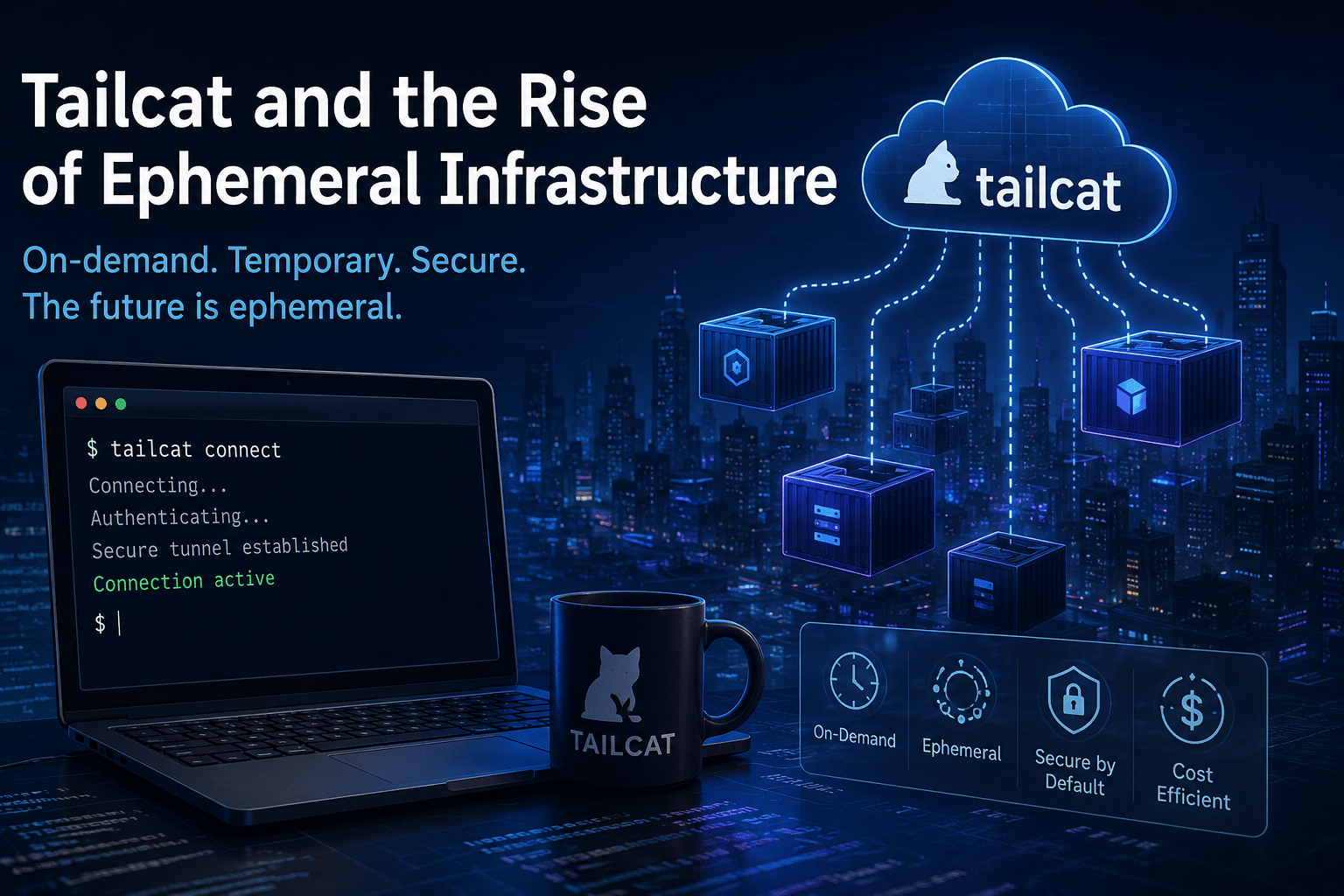
Perhaps the most important reason Tailcat is interesting today is timing.
Infrastructure is becoming increasingly ephemeral.
A traditional server might run for years.
A modern workload might run for:
- Five minutes
- One build
- One automated test
- One AI task
- One deployment
- One debugging session
Cloud platforms make it easy to create compute resources quickly.
Containers make workloads portable.
CI/CD platforms create temporary runners automatically.
AI systems increasingly generate and destroy their own execution environments.
But networking often remains relatively static.
This creates a mismatch.
Modern Compute
Create → Run → Complete Task → Destroy
Traditional Networking
Create Identity
↓
Configure Network
↓
Configure Policies
↓
Configure Access
↓
Maintain Infrastructure
Tailcat represents an attempt to make connectivity more compatible with ephemeral computing.
The connection can exist for the task.
The task ends.
The infrastructure relationship does not necessarily need to become permanent.
Why AI Agents Are an Especially Interesting Use Case
The rise of agentic AI may be one of the strongest use cases for technology like Tailcat.
AI agents increasingly interact with external computing environments.
An agent may need to:
- Access a sandbox
- Test an application
- Connect to a temporary virtual machine
- Move development files
- Run experiments on remote hardware
- Interact with a disposable test environment
Traditional authentication workflows can create friction.
An AI agent may not be designed to:
- Complete an SSO login
- Respond to multi-factor authentication
- Manage long-term user credentials
- Join an organization’s persistent network
More importantly, you may not want it to.
A temporary task should not automatically require permanent access.
Tailscale’s announcement specifically discusses using Tailcat with sandboxed AI agents and temporary or untrusted environments, highlighting workflows where agents can connect to systems for specific tasks without needing to join a persistent tailnet.
This points toward an important infrastructure principle:
The lifetime of access should increasingly match the lifetime of the task.
That concept could become fundamental as autonomous systems gain greater access to computing resources.
Tailcat and Remote Development
Remote development is another obvious application.
Developers frequently work across multiple environments:
- Local laptops
- Cloud servers
- Containers
- Test machines
- Raspberry Pis
- Virtual machines
Each environment creates a connectivity question.
Consider a developer who launches a temporary Linux server for testing.
The server might run:
- Docker
- PostgreSQL
- Redis
- A development API
- A machine learning workload
The developer needs to access it for a few hours.
A permanent VPN setup may be unnecessary.
Opening public ports may be undesirable.
Tailcat offers another possibility: establish a targeted encrypted connection between the development machine and the temporary environment.
This is where cloud infrastructure and lightweight connectivity naturally complement one another.

The Role of Linux VPS Infrastructure
Tailcat solves a connectivity problem.
But it does not eliminate the need for infrastructure.
Developers still need machines to run workloads.
They need:
- CPUs
- RAM
- Storage
- Linux distributions
- Root-level administration
- Persistent application environments
- Network capacity
This is where Linux VPS infrastructure remains important.
A Linux VPS can provide the stable compute layer while lightweight networking tools handle temporary connectivity between environments.
For example, a developer could use a Linux VPS for:
- Application development
- Container hosting
- Automation
- Testing
- Remote build workloads
- Development databases
- Self-hosted services
99RDP offers Linux VPS hosting positioned around high-performance virtual server workloads, giving users a configurable Linux environment for applications and infrastructure projects.
The strategic relationship between a VPS and a tool like Tailcat is straightforward.
The VPS provides the compute environment.
Tailcat can provide temporary connectivity.
Neither replaces the other.
Instead, they address different layers of the infrastructure stack.
How 99RDP Linux VPS Can Complement Modern Connectivity Workflows
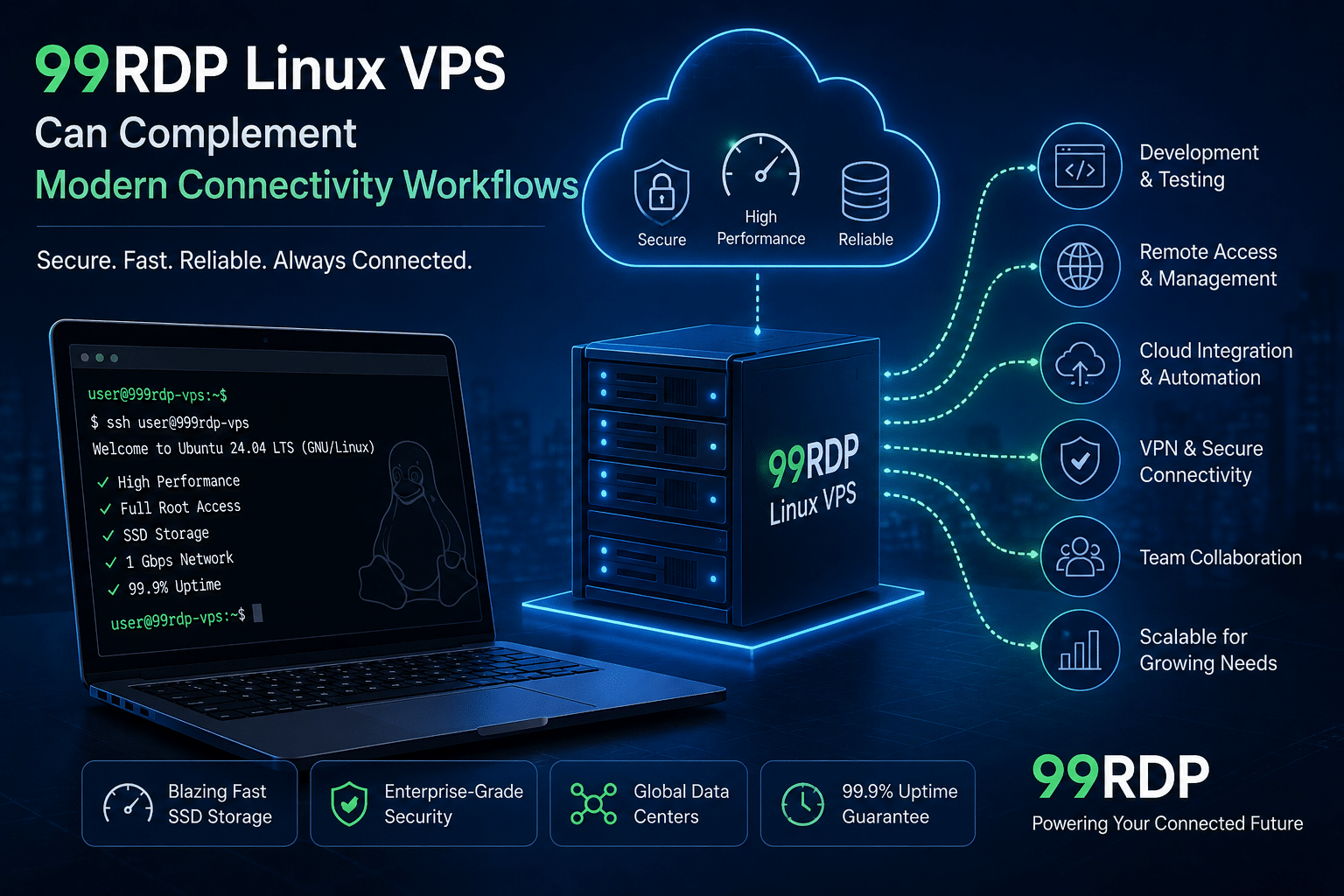
As development environments become more distributed, cloud servers increasingly act as persistent anchors for otherwise temporary workflows.
A developer might maintain a Linux VPS while connecting to it from:
- A laptop
- A temporary CI environment
- A sandbox
- Another cloud server
- An automation system
A service such as 99RDP’s Linux VPS can provide the underlying server environment for these workloads, while developers choose networking tools based on the access pattern they need.
For example:
Scenario 1: Persistent VPS + Temporary Development Access
A Linux VPS runs a development environment continuously.
A developer needs temporary access from a laptop behind NAT.
Rather than designing an entirely new networking relationship for every experimental workflow, lightweight connectivity tools can reduce friction.
Scenario 2: Cloud Testing Environment
A development team provisions temporary test servers.
Each server exists only for the duration of a test.
Tailcat-style connectivity can potentially support targeted machine-to-machine communication without requiring every temporary resource to become part of a permanent network.
Meanwhile, VPS infrastructure provides the underlying compute environment.
Scenario 3: Distributed Automation
An automation workflow may involve:
Developer Machine
       ↓
Linux VPS
       ↓
Temporary Test VM
       ↓
AI Agent Sandbox
Each environment has different trust and lifetime characteristics.
A modern architecture can avoid treating every connection identically.
Persistent infrastructure can use persistent governance.
Temporary tasks can use temporary connectivity.
That flexibility is increasingly valuable.
Direct Connections Matter for Performance
One reason NAT traversal technology is so important is performance.
Relaying all traffic through a centralized server introduces an additional network hop.
That can increase:
- Latency
- Bandwidth costs
- Infrastructure dependency
Direct peer-to-peer connections can often provide better network efficiency.
This matters for workloads such as:
- File transfers
- Remote development
- Interactive shells
- Distributed computing
- Game networking
- GPU workloads
However, it is equally important to understand the limitations.
Direct connectivity is not guaranteed.
Network policies, NAT behavior, and firewalls can prevent successful peer-to-peer communication.
A well-designed connectivity system therefore needs both:
- A direct path strategy
- A reliable fallback
Tailcat’s architecture reflects this principle.
The Importance of DERP Fallback
Some networking tools treat relays as a failure.
A better perspective is that relays provide resilience.
Consider a restrictive corporate network that blocks outbound UDP traffic.
No amount of clever NAT traversal can establish a UDP path if the firewall simply discards every relevant packet.
This creates a more resilient architecture.
Instead of:
Direct Connection Works?
       |
      No
       |
   Connection Fails
You get:
Direct Connection Works?
      / \
    Yes  No
    |     |
 Direct  Relay
 Path    Fallback
This philosophy is essential for real-world networking.
The internet is not a clean laboratory environment.
Networks contain:
- Legacy routers
- Carrier NAT
- Enterprise firewalls
- Cloud NAT gateways
- Security appliances
- Different routing policies
Connectivity tools must handle the messy reality.
Tailcat Is Userspace-Only
Another technically important aspect of Tailcat is its userspace approach.
Traditional VPN software may create:
- TUN devices
- Virtual interfaces
- Routing table changes
- System-level network configuration
Tailcat deliberately avoids becoming a system-wide networking layer.
This can be particularly useful in restricted environments.
Consider:
- Sandboxed environments
- Containers
- Untrusted virtual machines
- Systems where you lack administrator privileges
- Temporary compute resources
Sometimes you do not want to change the host networking configuration.
You simply want an application-level connection.
Tailcat is designed around that narrower objective.
Security: Simplicity Does Not Mean Less Responsibility
Tailcat removes many administrative layers.
That simplicity is useful.
But it also means users must understand the security model.
A Tailcat address should be treated as sensitive information.
This creates an important operational rule:
A connection address can function like a capability.
If someone possesses it, they may be able to initiate the relevant connection.
Therefore, users should avoid:
- Posting addresses publicly
- Committing addresses to Git repositories
- Including addresses in screenshots
- Sending addresses through insecure channels
- Logging sensitive connection details unnecessarily
Security still requires discipline.
Encryption protects data in transit.
It does not automatically protect credentials that users accidentally publish.
Tailcat Is Not a Replacement for Tailscale
One of the most important distinctions in the Tailcat announcement is that Tailcat intentionally does less than Tailscale.
Tailscale provides a broader networking platform with features around:
- Identity
- Device management
- Access controls
- Policies
- Governance
- Persistent networking
Tailcat intentionally excludes these layers.
This is not a weakness.
It is the point.
Tailcat is optimized for a narrower problem.
If you need to connect two machines quickly for a temporary task, you may not need an entire identity and governance platform.
But if you operate an organization with:
- Multiple teams
- Sensitive production systems
- Compliance requirements
- Persistent infrastructure
- Complex access policies
Then governance becomes essential.
The lesson is broader than Tailcat.
Infrastructure tools should be selected according to the problem they solve.
The Emerging Architecture of Ephemeral Access
Tailcat reflects a broader infrastructure trend.
We are moving away from the assumption that access must always be permanent.
Instead, infrastructure increasingly supports multiple access lifetimes.
Persistent Access
Used for:
- Production systems
- Long-term teams
- Organizational infrastructure
Session-Based Access
Used for:
- Remote administration
- Temporary debugging
- Development sessions
Task-Based Access
Used for:
- Automation
- CI/CD
- AI agents
- Temporary workflows
Ephemeral Access
Used for:
- Disposable environments
- Sandboxes
- Short-lived experiments
Different workloads need different connectivity models.
This suggests that the future infrastructure stack may become increasingly composable.
A Modern Infrastructure Stack Could Look Like This
Consider a hypothetical development architecture.
Layer 1: Compute
This includes:
- Linux VPS
- Cloud instances
- Containers
- Virtual machines
Layer 2: Application Platform
This includes:
- Docker
- Kubernetes
- Databases
- APIs
- Background services
Layer 3: Connectivity
This includes:
- SSH
- Tailscale
- Tailcat
- Reverse proxies
- Service meshes
Layer 4: Identity and Governance
This includes:
- SSO
- Access policies
- Role-based permissions
- Audit logs
Layer 5: Automation
This includes:
- CI/CD
- Infrastructure as Code
- AI agents
- Deployment systems
The important insight is that these layers do not need to be permanently tied together.
You might use:
- Tailscale for persistent organizational networking
- Tailcat for temporary machine-to-machine connectivity
- A Linux VPS for compute
- Docker for application isolation
Composable infrastructure allows teams to choose the right tool for each layer.
Self-Hosted DERP and Infrastructure Control
Tailcat also creates interesting opportunities for organizations that want more control over relay infrastructure.
This opens a potential architecture such as:
                ┌─────────────────┐
                │   Linux VPS     │
                │                 │
                │ Self-Hosted     │
                │ DERP Service    │
                └────────┬────────┘
                         │
             ┌───────────┼───────────┐
             │           │           │
          Machine A   Machine B   Machine C
A Linux server can provide infrastructure for organizations experimenting with:
- Custom relay deployments
- Distributed systems
- IoT networking
- Private connectivity experiments
- Peer-to-peer applications
Of course, self-hosting introduces responsibility.
You must consider:
- Availability
- Geographic location
- Monitoring
- Security updates
- Bandwidth
- Scaling
This is where reliable cloud infrastructure becomes important.
A VPS is not merely a place to host a website anymore.
It can become a building block for networking experiments and distributed infrastructure.
Potential Use Cases for Tailcat
Tailcat’s design makes several use cases particularly interesting.
1. Temporary SSH Access
You need access to a development machine for an hour.
A persistent network configuration may be unnecessary.
A temporary encrypted connection may be more appropriate.
2. File Transfers
You need to move files between machines on different networks.
Instead of relying on a public storage intermediary, a direct encrypted connection may be useful.
3. AI Agent Sandboxes
An AI agent needs access to a test environment.
You want the access to remain limited to a specific workflow.
Tailcat’s lightweight model fits this type of scenario.
4. CI/CD Environments
Build systems frequently create temporary workers.
Giving each worker a permanent network identity can create unnecessary complexity.
Task-specific connectivity may provide a more natural approach.
5. Remote Hardware Experiments
Developers sometimes work with:
- Raspberry Pis
- GPUs
- Edge devices
- Embedded systems
These machines may sit behind NAT or restrictive networks.
Automatic connectivity techniques can simplify experimentation.
6. Distributed Development
Teams often operate across:
- Local laptops
- Cloud servers
- Temporary VMs
- Test environments
A flexible connectivity layer can reduce friction between these systems.
Why Tailcat Matters Beyond Tailscale
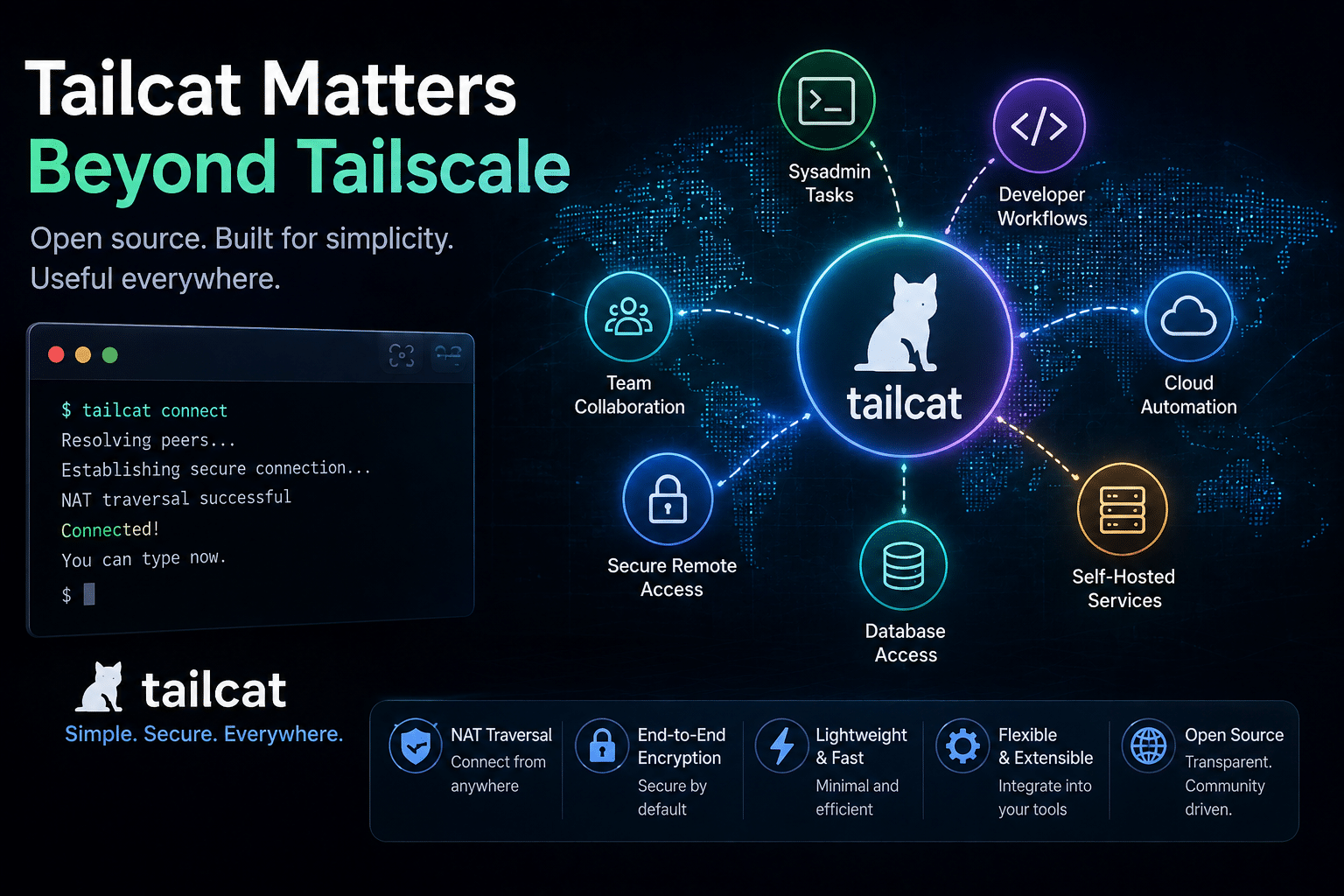
The most interesting aspect of Tailcat may not be the tool itself.
It may be the architectural philosophy it represents.
For years, infrastructure has often moved toward larger platforms.
More features.
More dashboards.
More configuration.
More identity layers.
More abstraction.
Tailcat goes in the opposite direction.
It extracts a useful subset of a sophisticated networking system and packages it into a focused tool.
This is part of a larger trend toward composability.
Developers increasingly prefer tools that:
- Solve specific problems
- Work from the command line
- Integrate into automation
- Avoid unnecessary setup
- Can be used temporarily
- Do not require permanent infrastructure relationships
Tailcat demonstrates that powerful infrastructure technology does not always need to expose every component to the user.
Sometimes the best abstraction is simply:
Listen
↓
Share
↓
Connect
The complexity still exists underneath.
But the user does not need to manually manage it.
Tailcat and the Future of Cloud Infrastructure
Cloud infrastructure is also becoming more flexible.
A developer can provision a server in minutes.
Containers can launch in seconds.
AI systems can create temporary execution environments automatically.
The next challenge is making networking equally dynamic.
Imagine a future workflow:
AI Agent Receives Task
        ↓
Creates Temporary Environment
        ↓
Provisions Compute
        ↓
Creates Secure Connection
        ↓
Runs Workload
        ↓
Transfers Results
        ↓
Destroys Environment
This entire workflow could happen automatically.
The infrastructure exists only as long as necessary.
The access exists only as long as necessary.
The networking relationship disappears with the workload.
That is a fundamentally different model from traditional enterprise networking.
And it may become increasingly common.
How Developers Should Think About Tailcat Today
Tailcat should not automatically replace existing networking infrastructure.
Instead, developers should evaluate it according to its intended strengths.
Consider Tailcat when:
- You need temporary connectivity.
- Two machines are on different networks.
- NAT makes direct access difficult.
- You want a lightweight CLI workflow.
- Persistent network membership is unnecessary.
- You work with ephemeral or untrusted environments.
- You need automation-friendly connectivity.
Consider a broader networking solution when:
- You need identity management.
- You need access policies.
- You manage multiple users.
- You require audit logs.
- You operate persistent infrastructure.
- You need organizational governance.
And remember that connectivity is only one part of the architecture.
You still need reliable compute infrastructure.
Final Thoughts: The Network Does Not Always Need to Be Permanent
Tailcat arrives at an interesting moment in computing.
Infrastructure is becoming more temporary.
AI agents are becoming more autonomous.
Cloud workloads are increasingly disposable.
Development environments span more machines and networks than ever before.
Yet networking often remains rooted in a world of permanent relationships.
Tailcat challenges that assumption.
Infrastructure should adapt to the lifetime of the workload.
Persistent applications need stable compute.
Organizations need identity and governance.
Production systems need carefully managed access.
But temporary tasks may only need temporary connectivity.
This is where the combination of flexible compute infrastructure and lightweight networking becomes powerful.
A Linux VPS provides the environment where applications, services, automation, and experiments can run. Services such as 99RDP’s Linux VPS platform can serve as that underlying compute layer for developers building and testing server-side workloads.
Meanwhile, tools like Tailcat explore a simpler answer to the connectivity problem.
Not every machine needs to join a permanent network.
Sometimes, you simply need two machines to talk securely.
And sometimes, that is enough.
As cloud infrastructure becomes more dynamic, networking may follow the same path.
The future may not belong exclusively to larger, more complex networks.
It may also belong to smaller, temporary, encrypted connections created exactly when they are needed—and disappearing when the job is done.
EXPLORE MORE ; Why Corporate Workloads Perform Better on 99RDP Dedicated Servers

READ OUR BLOGS


