
Why Corporate Workloads Perform Better on 99RDP Dedicated Servers

The New Reality of Enterprise IT
Corporate IT leaders are facing a fundamental shift in how infrastructure decisions are made. A decade ago, the primary concern was simply keeping applications online. Today, the expectations are much higher. Businesses demand real-time performance, continuous availability, stronger cybersecurity, predictable operational costs, and infrastructure capable of supporting AI, big data, and globally distributed teams.
Cloud computing transformed enterprise IT by making infrastructure easier to deploy and scale. However, many organizations have discovered that cloud is not always the most economical or performance-efficient option for every workload. As applications mature and workloads become predictable, businesses often begin evaluating dedicated infrastructure to gain greater control over performance and long-term costs.
This is where 99RDP Dedicated Servers offer a compelling solution. By providing exclusive access to enterprise-grade hardware, 99RDP enables organizations to run demanding workloads without the resource contention, unpredictable billing, or shared infrastructure limitations commonly associated with multi-tenant environments.
Dedicated servers are no longer just an alternative—they have become a strategic choice for organizations that prioritize performance, security, and operational stability.
Understanding Modern Corporate Workloads

Today’s enterprises operate a diverse portfolio of applications, each with unique infrastructure requirements. Unlike small business websites or personal projects, corporate workloads often involve thousands of simultaneous users, complex databases, and business-critical transactions that cannot tolerate delays.
Common enterprise workloads include:
- Enterprise Resource Planning (ERP)
- Customer Relationship Management (CRM)
- Financial systems
- Healthcare applications
- AI and machine learning platforms
- Business intelligence dashboards
- High-volume databases
- Virtual Desktop Infrastructure (VDI)
- SaaS platforms
- E-commerce ecosystems
- Media streaming
- Development and testing environments
- Virtualization clusters
Each of these workloads requires consistent CPU performance, sufficient memory, fast storage, and reliable networking. Any fluctuation in infrastructure performance can directly impact employee productivity, customer experience, and business revenue.
The Problem with Shared Infrastructure
Many hosting environments operate on shared resources. While this model reduces costs for smaller websites, it introduces significant challenges for enterprise workloads.
These include:
- Resource contention
- CPU throttling
- Memory limitations
- Storage bottlenecks
- Noisy neighbor effects
- Variable network performance
Imagine a financial reporting application slowing down during month-end processing because another tenant on the same physical host suddenly experiences a traffic spike. Even though your application is functioning correctly, shared infrastructure becomes the bottleneck.
Dedicated servers eliminate this uncertainty.
Why Dedicated Infrastructure Delivers Better Performance
One of the biggest advantages of a dedicated server is exclusivity.
Every processor core, every gigabyte of RAM, every storage device, and every network interface belongs entirely to your organization.
This results in:
- Predictable CPU utilization
- Stable memory availability
- Consistent disk performance
- Lower latency
- Faster application response
- Improved database throughput
Instead of competing for shared resources, enterprise applications run at their full potential.
For customer-facing applications where milliseconds influence user satisfaction, this consistency can translate directly into higher conversions and better customer retention.
Why 99RDP Makes Sense for Corporate IT
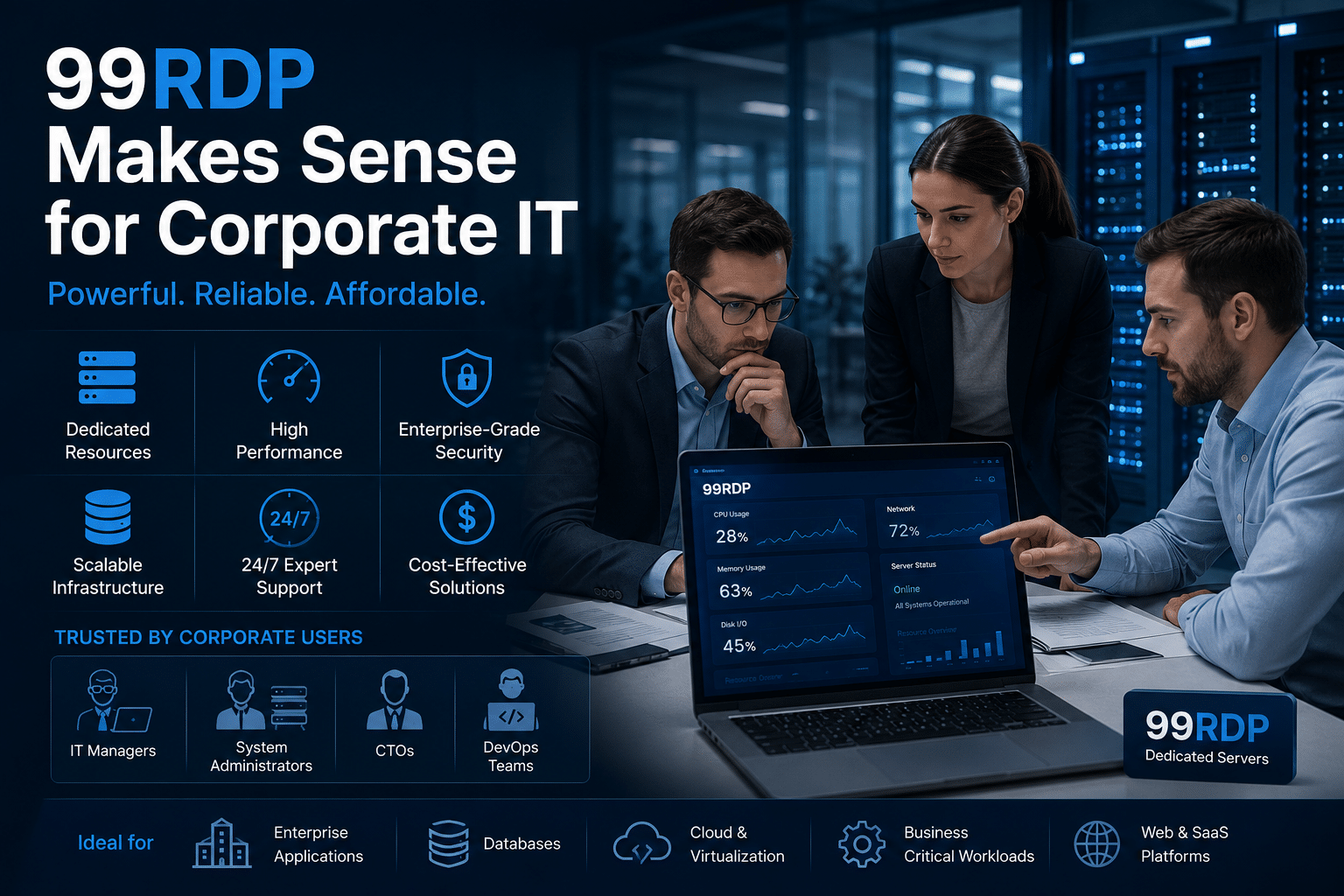
99RDP focuses on delivering dedicated infrastructure designed for businesses that require reliability without unnecessary complexity.
For corporate IT departments, the platform offers several practical advantages:
Dedicated Hardware
Exclusive physical resources ensure maximum application performance.
Flexible Server Configurations
Businesses can select hardware specifications aligned with workload requirements instead of paying for unnecessary resources.
High-Speed Storage
Modern SSD and NVMe storage significantly reduce database query times and application loading speeds.
Enterprise Connectivity
Reliable network infrastructure helps maintain consistent performance for globally distributed teams and customers.
Multiple Operating Systems
Support for Linux and Windows environments enables organizations to deploy workloads using familiar technologies.
Scalable Infrastructure
As business demands grow, dedicated resources can be upgraded without fundamentally changing the hosting model.
Security Is No Longer Optional
Cybersecurity has become one of the most significant priorities for enterprise IT.
Modern attacks target:
- Customer databases
- Financial systems
- Authentication platforms
- Intellectual property
- Cloud storage
- Remote access systems
Dedicated infrastructure strengthens security by reducing exposure to shared-resource vulnerabilities.
Benefits include:
- Complete operating system control
- Custom firewall implementation
- Security policy enforcement
- Private networking
- Dedicated IP addresses
- Improved audit capabilities
Organizations can implement security architectures aligned with internal compliance requirements instead of adapting to shared hosting limitations.
Performance During Peak Business Hours
Traffic patterns are rarely consistent.
Retail businesses experience seasonal spikes.
Financial organizations see increased activity during trading hours.
Educational institutions handle enrollment periods.
Media companies experience viral traffic.
Corporate workloads require infrastructure capable of sustaining peak demand without performance degradation.
Dedicated servers provide reserved computing capacity that remains available regardless of external demand.
This ensures business continuity even during the organization’s busiest operational periods.
Database Performance Matters
Enterprise applications are only as fast as their databases.
Whether using MySQL, PostgreSQL, Microsoft SQL Server, MariaDB, or MongoDB, database performance determines:
- Dashboard loading
- Reporting speed
- Search functionality
- Transaction processing
- Analytics execution
Dedicated servers improve database responsiveness by providing:
- Faster storage access
- Larger memory allocation
- Stable CPU resources
- Better caching efficiency
For data-intensive organizations, these improvements significantly enhance overall application performance.
Supporting Hybrid and Remote Workforces
Corporate work has changed permanently.
Employees now access business applications from offices, homes, and client locations across multiple regions.
Reliable infrastructure is essential for maintaining productivity.
Dedicated servers support:
- VPN gateways
- Remote desktops
- Collaboration platforms
- Internal portals
- File management systems
- Business applications
Because hardware resources remain dedicated, remote employees experience more consistent performance even during heavy organizational usage.
AI, Analytics, and Data Processing
Artificial Intelligence has become part of mainstream enterprise operations.
Organizations now deploy AI for:
- Customer service automation
- Predictive analytics
- Fraud detection
- Recommendation engines
- Image processing
- Natural language processing
These workloads consume substantial processing power.
Dedicated servers provide uninterrupted computational resources necessary for AI model training, inference, and large-scale data analysis.
Predictable Costs Improve IT Planning
One challenge many enterprises encounter with usage-based infrastructure is budget uncertainty.
Monthly invoices may fluctuate because of:
- Traffic spikes
- Storage growth
- Network bandwidth
- Compute utilization
- Backup services
- Additional cloud resources
Dedicated servers simplify financial planning.
Organizations know their infrastructure costs in advance, making budgeting easier and reducing unexpected operational expenses.
This predictability is particularly valuable for CFOs and procurement teams managing annual IT budgets.
Better Control for IT Administrators
Enterprise IT teams require flexibility.
Dedicated servers allow administrators to:
- Install custom software
- Optimize operating systems
- Configure virtualization
- Deploy monitoring tools
- Implement backup strategies
- Customize security policies
- Schedule maintenance windows
This level of control is often limited in shared hosting environments.
High Availability Starts with Reliable Infrastructure
Business downtime affects more than technology.
It impacts:
- Revenue
- Customer trust
- Employee productivity
- Brand reputation
- Regulatory compliance
Reliable infrastructure forms the foundation of high availability.
Combined with proper backup, monitoring, redundancy, and disaster recovery planning, dedicated servers help organizations minimize operational disruptions.
Industry Use Cases
Financial Services
Banks, fintech startups, and accounting firms require secure transaction processing and low-latency databases.
Dedicated servers provide stable infrastructure for financial applications while supporting strict security requirements.
Healthcare
Healthcare providers process confidential patient information.
Dedicated infrastructure offers greater control over application environments and security configurations supporting compliance initiatives.
SaaS Companies
Software-as-a-Service providers depend on consistent application responsiveness.
Dedicated servers reduce performance variability while enabling customized application optimization.
Manufacturing
Manufacturers increasingly rely on ERP systems, IoT platforms, and production analytics.
Reliable infrastructure ensures uninterrupted operational visibility across production environments.
Education
Universities and online learning platforms manage thousands of concurrent users.
Dedicated servers support learning management systems, digital libraries, and online examination platforms with consistent performance.
E-Commerce
Slow websites directly affect sales.
Dedicated servers improve page loading, inventory synchronization, payment processing, and checkout experiences during high-traffic events.
When Should an Organization Choose Dedicated Servers?

Dedicated infrastructure is ideal when:
- Applications run continuously
- Performance consistency is critical
- Large databases are involved
- Security requirements are strict
- Compliance obligations exist
- Custom configurations are required
- Infrastructure costs need to remain predictable
- Growth projections justify dedicated resources
Organizations with mission-critical workloads often find dedicated infrastructure becomes a long-term strategic investment rather than simply another hosting expense.
Why 99RDP Stands Out
Corporate buyers evaluate hosting providers based on reliability, flexibility, support, and value—not just price.
99RDP addresses these priorities by offering:
- Dedicated physical servers
- Flexible configuration options
- Competitive pricing
- High-performance storage
- Business-ready hosting environments
- Infrastructure suitable for demanding enterprise applications
Rather than forcing businesses into one-size-fits-all hosting plans, 99RDP enables organizations to select infrastructure aligned with their operational goals.
Best Practices for Deploying Corporate Workloads
To maximize the benefits of dedicated infrastructure:
- Implement automated backups.
- Use redundant storage where appropriate.
- Monitor CPU, RAM, and storage utilization.
- Enable proactive security monitoring.
- Apply regular operating system updates.
- Use load balancing for high-traffic applications.
- Document disaster recovery procedures.
- Continuously review capacity planning.
Infrastructure performs best when supported by disciplined operational practices.
The Future of Enterprise Infrastructure
Enterprise IT is evolving toward a balanced approach. Rather than relying exclusively on public cloud or on-premises infrastructure, organizations are increasingly adopting hybrid strategies that combine the strengths of multiple deployment models.
Dedicated servers play a crucial role in this evolution by providing predictable performance for core business applications while allowing cloud platforms to handle burst workloads, testing environments, or globally distributed services.
As AI adoption, cybersecurity demands, and regulatory requirements continue to grow, the value of dedicated infrastructure is likely to increase for organizations seeking greater control over their technology stack.
Conclusion
Corporate workloads demand more than basic hosting. They require consistent performance, robust security, operational flexibility, and financial predictability. Shared infrastructure can meet the needs of small projects, but mission-critical enterprise applications often benefit from dedicated resources that eliminate contention and provide full administrative control.
99RDP Dedicated Servers offer organizations a practical path toward enterprise-grade infrastructure without unnecessary complexity. By combining dedicated hardware, scalable configurations, and business-focused hosting capabilities, 99RDP enables companies to support demanding applications, improve user experience, and plan infrastructure investments with confidence.
For CIOs, CTOs, IT managers, and business leaders evaluating the future of their infrastructure, the key question is no longer whether dedicated servers remain relevant. The real question is which workloads deserve the stability, performance, and control that only dedicated infrastructure can provide. For many organizations, that answer begins with a dedicated server strategy—and 99RDP is well positioned to be part of that journey.
EXPLORE MORE ; Ghostty’s Scrollbar Feature Meets High-Performance Linux RDP

READ OUR BLOGS


